
The Autism Society Philippines (ASP) is a national, non-profit organization dedicated to the well-being of persons on the autism spectrum disorder. We envision a society where Filipinos on the spectrum become the best of their potentials -- self-reliant, independent, productive, socially-accepted citizens of an Autism-OK Philippines.

25 April 2012

Autism Binds: Our Family’s Journey

By Mona Magno-Veluz

Acceptance, in baby steps

My husband and I had lofty dreams when we married in 1991. Our son, Carlo Gregorio, was born more than a year after we married and was a celebrated addition, being the first male grandchild to my parents. He grew into a handsome and energetic toddler, who received so much love from his grandparents, aunts, uncles and cousins.

Amidst the joy, I began to notice little idiosyncrasies; and being the new mom that I was, I brushed them off as personality quirks. Professionals soon gave us a name for the condition my son suffered – AUTISM.

In the beginning, the possibility that my son, as some doctors told us, might not even finish grade school gnawed at me. I was afraid that my son will be “least favoured” in my family for his intellectual limits, as we have always put a great importance on academic accomplishment. I was embarrassed for my son’s social faux pas, scared that he will not grow out of them. Of course, there was that unspoken sense of guilt – I searched my brain for things I did or food I ingested during my pregnancy that could have damaged my son so irreparably.

Special bonds

My husband, who had always been more accepting and laid-back, was confident that we could work together to help Carl be the best he could be. He became my rock and strength when our small son became exceptionally difficult. And contrary to my early fears, our families have been paragons of generosity of spirit – helping us when we needed respite and loving Carl unconditionally. My father and brother have formed special bonds with my Carl – three generations of Carl’s! My sister would give me “alone time”, taking Carl out to give me a few hours of quiet. His cousins would rush to his aide when other kids are less than kind to Carl. Our own cousins seem oblivious to his weaknesses, offering only encouragement at Carl’s improvement at every family reunion. I know our journey has been made easier by the kindness our extended family has shown over the years.

In hindsight, it was when I tore the weight of negativity from my shoulders, when I began to look at my son’s autism as part of our family’s bucket of challenges that I was able to help Carl better. I have become more confident about talking about the challenges of autism to other parents, welcoming the opportunity to help find answers to questions or to simply compare notes. My husband and I were able to help our some cousins and friends when their children were also diagnosed with autism. Carl’s younger siblings — 12 and 8 years old — are themselves growing up to be outspoken autism advocates. The sense of humour helped too.

The theme of this year’s National Autism Conference on 28-29 April 2012 at the Crowne Plaza in Pasig, strikes very close to home. We, like many parents, are taking each challenge as it comes, at peace with the fact that our family is strong because the challenges of autism bind us to become stronger. It is the families touched by autism that propels people to work towards autism awareness, education and advocacy.

Carl and the future

Carl, a typical teenager in many ways.

Now 19 years old, Carl has graduated from high school and has enrolled at Independent Living and Learning Center, where he has been honing his social skills and practicing college-appropriate classroom behaviour. This year, he is entering their Job Readiness Program and will be interning in an office. My husband and I are thankful for institutions like ILLC which has coached Carl into the promising young adult he is today.

Like any regular teenager, Carl loves to spend time with his friends and teachers — on the phone and on Facebook. He enjoys school-sanctioned dance parties, community trips and school programmes; and has hosted several school events and family reunions. He participated in the Special Collection 2010 in UP Diliman, a fashion show starring PWDs; and is a member of the ILLC Hunks, a dance group that performs regularly at autism community events.

Carl has always been enamoured by the stories of the taipans of Philippine business; and dreams of becoming an industrialist himself. We helped Carl organize “Gregarious Gifts” (http://www.facebook.com/gregariousgifts) – a venue where he can create and market hand-made products. When there is an upcoming bazaar, the entire family pitches in and helps Carl meet his volumes.

Despite the distance Carl has gone, the future is still a scary entity. But among all the institutions out there designed to help individuals with autism, the hardest-working, steadiest, most consistent group I know, that will help Carl through thick and thin, is our FAMILY. And that thought brings me a semblance of peace.

An edited version of this original article was first published in the Manila Bulletin print version and online versions on 23 April 2012.

*****

Mona Magn-Veluz is a graduate of Business Administration University of the Philippines. She continued with further studies in Applied Business Economics and Strategic Marketing at the University of Asia and the Pacific and the London School of Business. As a practicing marketing communications professional, she has held various global management roles in Ericsson Telecommunications, Telus International and Emerson Network Power. As an ASP member, she had taken her autism rights advocacy into the social media arena by blogging and tweeting about hermany adventures as "Mighty Magulang".

24 April 2012

Hope Is At Home

By Dang U. Koe, ASP Chair Emeritus

A diagnosis of autism does not only affect the person, it affects the entire family, the parents as well as the siblings. The diagnosis of autism poses insurmountable challenges that can make or break this basic social institution, the family.

Feelings of shock, anger, helplessness and incompetence dominate the family; thus they tend to rely heavily on professionals to address the needs of their family member with autism. Families lose confidence to take on their crucial role as the lead in autism management, and instead take on passive roles through years of various interventions and huge expenditures.

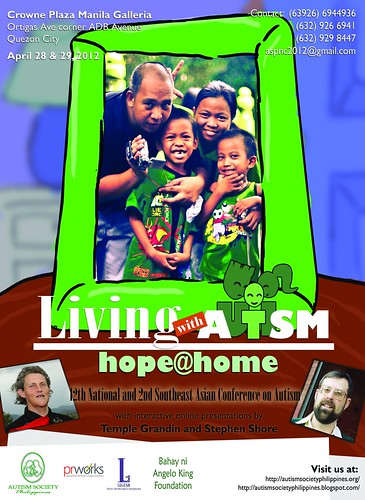
Autism Society Philippines (ASP) will hold its 12th National Conference on Autism and 2nd Southeast Asian Conference on Autism on April 28 and 29, with theme “Living with Autism” Hope@Home” at Crowne Plaza Manila Galleria, Ortigas Ave. corner ADB Avenue, Quezon City.

This year’s conference aims to promote, first and foremost, acceptance of autism within the family. It seeks to empower families to make informed decisions and to take bolder steps to ensure quality life for their member with autism.

It will also provide a fresh perspective to professionals as collaborative and supportive partners of families in the management of autism.

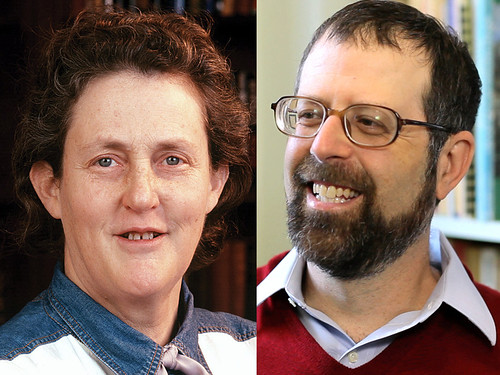
Dr. Temple Grandin and Stephen Shore

It will feature interactive web interviews with Dr. Temple Grandin and Dr. Stephen Shore, two of the world’s most famous experts on autism.

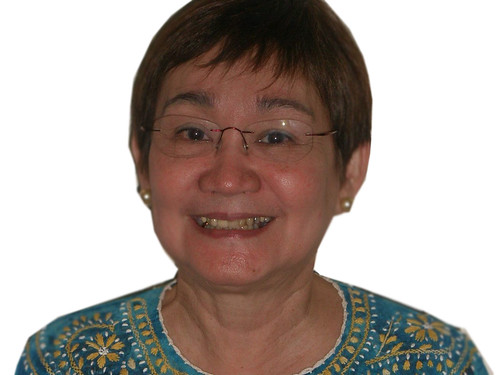
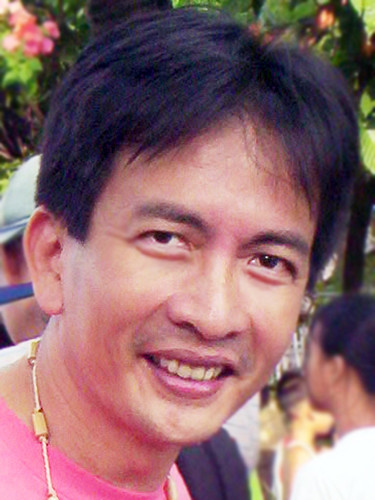
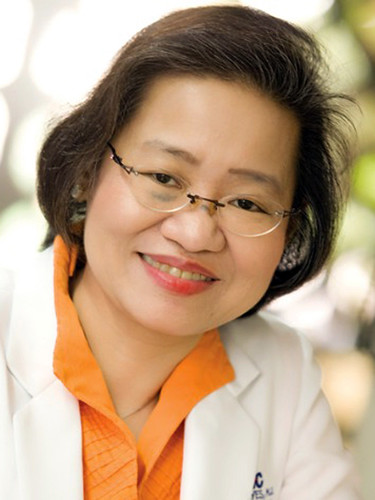
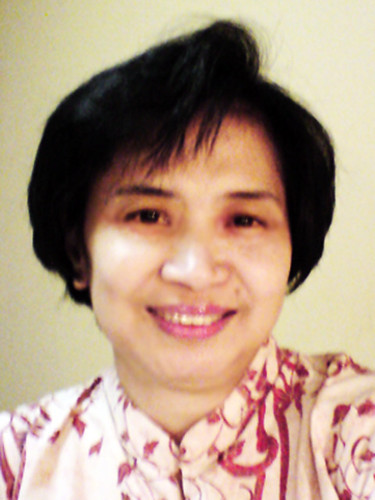
Dr. Alexis Reyes, Dr. Michael Tan, Dr. Honey Carandang and Dr. Josefina Lapeña

It will also feature Filipino experts — developmental pediatrician Dr. Alexis L. Reyes, Dr. Michael Tan, and Dr. Honey Carandang and Dr. Josefina Isidro-Lapeña (Family Physician) and will showcase local experiences of parents, siblings and persons with autism as self advocates.

Ms. Dahila Loyola and Mr. Barney McGlade

It will also feature initiatives of the government (Carmona, Cavite) and the private sector in “Community Based Rehabilitation (CBR)”, both in the rural and urban settings, to provide programs and services for families and communities facing the challenges of autism.

For registration and other details, email aspnc2012@gmail.com.

Re-published with permission from Manila Bulletin

23 April 2012

Campaign to increase PWD’s electoral participation set

Comelec logo
Anticipating the forthcoming 2013 Philippine midterm elections, a group of organizations working with persons with disabilities (PWDs) is launching a nationwide campaign that aims to increase the participation of PWDs in the elections and other democratic processes.

Aptly called Fully Abled Nation, the campaign seeks to arrest the decline of PWD participation in previous polls. A recent Social Weather Stations (SWS) survey showed that the number of PWDs who actually voted has gone done from 60 percent in 2007 to 54 percent in the 2010 elections.

Commission on Election (COMELEC) Commissioner Rene Sarmiento, said there should be efforts to have accessible polling stations, ballots printed in Braille, sign language interpreters, a party-list representative for PWDs, and a PWD commissioner in the COMELEC for PWDs to be able to exercise their right of suffrage.

There is also a need to campaign among lawmakers to push the rights of the PWDs as voters, to nurture contacts with international agencies concerned with PWDs, establish regional networks, to have an ASEAN committee on PWDs, and for the agencies and groups to exchange best practices, said Sarmiento, who is COMELEC’s “focal person” in the Inter-Agency and NGO Network in Empowering PWDs.

Spearheaded by The Asia Foundation with the support of the Australian Agency for International Development (AusAID), Fully Abled Nation is part of a three-year Disability-Inclusive Elections Program which seeks to heighten voter awareness among PWDs, promote institutional partnerships to enhance support for their participatory needs, and strengthen the capabilities of disability peoples’ organizations (DPOs) and NGOs supporting PWD advocacies.

Fully Abled Nation will be launched on April 18, 2012, from 1:00 pm to 4:15 pm, at the Makati Shangri-La in Makati City. It will be hosted by the Australian Ambassador to the Philippines Hon. Bill Twedell and The Asia Foundation Acting Country Representative Ky Johnson.

Guest speakers will be Secretary Jesse Robredo of the Department of Interior and Local Government (DILG), and Chairman Sixto Brillantes, Jr. of COMELEC.

Expected to attend the launch are PWD champions from DPOs, NGOs, the academe, development work sector, international donor organizations, and key government agencies who will be signing the Declaration of Commitment to uphold the common struggle for PWD rights.

Various projects under the Fully Abled Nation campaign include an assessment of the situation of PWDs, focus group discussions and dedicated surveys nationwide, piloting electoral reform in Bohol, development and application of disability-inclusive volunteer management systems in Cebu, among others.

Last March 28, 2012, various sectors in Cebu City signed the Declaration of Commitment in support of the Fully Abled Nation. It was held at the Cebu Provincial Capitol. In attendance were some members of the Cebu provincial board, NGOs, and PWD champions from the academe and business sector.

Reprinted from Fully Abled Nation.

Good reasons to attend autism conference

By Chelo Banal-Formoso, Philippine Daily Inquirer

Living with Autism Hope@Home poster

Having shared a lot about parenting a child with autism in previous writings, I now don’t feel a need to preface this piece with a review of my son’s condition.

When you write every now and then about your son with autism, people you meet start talking to you as if they know him. “How’s Gabriel?” they ask. I don’t mind the familiarity. I consider it a bonus for writing for the top broadsheet in the country.

So let me cut to the chase.

If you are a parent, teacher, therapist, nurse or doctor to a person with autism—no matter what age—try to attend the Autism Society of the Philippines’ (ASP) conference on April 28-29 at the Crowne Plaza Hotel.

Temple Grandin, Ph.D., and Stephen Shore have agreed to do an interactive web discussion at the conference. These two professionals are themselves in the autism spectrum, so you will hear firsthand about their challenges and how they have coped with the same.

Grandin’s book, “Emergence: Labelled Autistic,” answered a lot of questions I had after my son’s diagnosis. Among the things I remember reading are: She didn’t like being hugged because she could not stand the smell of people (she has a heightened sense of smell, which my son also has); she invented a hugging machine that she used whenever she felt the need for a hug; her ideas have revolutionized the livestock industry.

Whatever deficits the autism condition bred in her, Grandin has more than made up for with the intellectual processes that have brought her a Ph.D. and a living as a professor of Animal Science at the Colorado State University.

I liked it that when Claire Danes won an acting award for playing the title role in the HBO movie “Temple Grandin,” the real Temple was shown in the audience wearing her signature cowgirl attire.

Shore, for his part, had to contend with a nonverbal early childhood and difficulties that prompted a recommendation to his parents to have him institutionalized.

To his luck, his parents refused and, as it turned out, he is a professor at Adelphi University. He is also a consultant on issues relating to education, relationships and employment for adults with autism.

Grandin and Shore are among the reasons I’m attending the ASP conference. I wish all parents of children with disability could go.

Whenever I’m at a conference, I can tell the parents of the newly diagnosed children. They sit quietly, eyes glistening from the tears that they try to keep to themselves. I was like them the very first time I attended a conference. I sat there with shards of fear in my heart.

I took away a lot from that first conference, so much so that the following year, I brought my husband with me and, in succeeding years, included Gabriel’s therapists.

The Internet no doubt can bring up a wealth of information about autism or any other disorder. But there is nothing more exciting and inspiring than being with people who share the same cause as yours—experts who can give updates on trends in treatments and teaching methods; teachers and therapists who are willing to go the distance for our children; parents who need to bounce frustrations off, as well as buoy up, one another.

The importance of being earnest in helping your autistic child cannot be overemphasized. But if you go to a conference and come away frustrated because the other kids are doing so much better than yours, you need to lighten up.

Go to educate yourself, to meet with kindred spirit, to share best practices, to give and receive hope and, above all, to get passionate all over again about the present and the future of your children.

See you there!

The 12th National Conference and 2nd Southeast Asian Conference on Autism will be held on April 28-29 at Crowne Plaza on Ortigas Avenue. Call 7-903-5496 or 0917-556-2075 or e-mail aspnc2012@gmail.com.

This article appeared in the print and online versions of the Philippine Daily Inquirer.

19 April 2012

PWDs can command 2.6M votes in 2013 polls

By Anna Valmero

UNCRPD logo
There are up to 2.7 million persons with disabilities (PWDs) in the country who are eligible to vote in the 2013 midterm elections, according to Department of Interior and Local Government (DILG) Jesse Robredo.

“Up to 2.6 million PWDs are qualified to vote in the 2013 midterm polls. That is a strong vote that candidates should consider and be accountable for after the polls,” said Robredo during the launch of the The “Fully Abled Nation.”

The project is a three year program implemented by the Asia Foundation, with support from the Australian Agency for International Development (AusAID) that aims to increase voting participation of PWDs in the 2013 midterm polls.

According to Commission on Elections (Comelec) Rene Sarmiento, there are 345,000 registered PWD voters in the May 2010 automated elections.However, only 53 percent of this figure cast the ballot.

“The number of PWDs registered with Comelec highlight that PWDs still find it difficult to register and vote. I agree with Commissioner Sarmiento that there is still a need for more accessible registration and voting precincts, ballots produced in Braille and sign language interpreters for hearing-impaired persons,” said Robredo.

Robredo, whose father and two brothers is suffering from hereditary blindness, said he knew the difficulties of enabling PWDs to register and cast their ballots during elections.

“It was the community of disabled themselves who tirelessly promote their rights of suffrage. Unless somebody accompanies the PWD voter, they will find it difficult and may fail to exercise their right to vote,” said the DILG chief.

According to the Social Weather Stations (SWS) survey of PWDs and Filipino Adults, registered PWD voters but did not vote rose from 14 percent from 2007 to 21 percent in 2010.

PWDs of voting age but did not register also increased from 20 percent to 22 percent, the survey showed.

SWS found that among those who did not vote in the 2010 elections, 17 percent were ashamed to vote because of their disability, another 17 percent because of mobility problems, 16 percent because they were either sick or bedridden, and 10 percent because nobody would shade or read the ballot for them.

“The disability sector has been active in claiming the right to suffrage. PWDs themselves do not think of themselves as disabled but those who view them as the invisible sector and a minority affect how they perceive themselves and their capabilities,” said said Maribel Buenaobra, director of programs at The Asia Foundation.

Inclusive development is the achievement of equal rights given to PWDs and all marginalized sectors of society, reiterated Octavia Borthwick, ministry chancellor, Australian Agency for International Development (AusAID).

“Inclusive development when it includes PWDs, everyone participates equally and benefits from the process. It is also when the society considers PWDs in the development process in terms of access to education and voting,” said Borthwick.

In Naga where he formerly served as mayor, Robredo sa

id that they encouraged PWD participation by giving them a seat at the Sangguniang Bayan table so the local government can better serve them. There are also libraries featuring books in Braille and computer programs that assist PWDs to navigate the web and use software, said Robredo.

“LGUs need to look closely and pay attention to the needs of PWDs. Probably more of them will listen more if they know that they will vote,” added Robredo.

Under the Magna Carta for Disabled Persons, every LGU must have an office for PWDs and allocate revenues for programs for the sector.

“Disability is a human rights issue—why we need wider doorways everywhere and ramps to grant access to our PWDs. There is one more thing PWDs need, the right to vote,” said Sarmiento, who headed the 2010 Comelec special committee for PWD registration and voting.

Earlier, Comelec launched special PWD lanes in special registration precincts in malls nationwide. PWDs may be assisted by a family member of legal voting age during the registration.

Re-published from Yahoo News Philippines.

*****

ASP is a member of the Philippine Coalition on UNCRPD. For more information, please call 7-903-5496 or email us at autismphils@gmail.com.

18 April 2012

1 Million Filipinos affected with Autism Need YOU!

Living with Autism Hope@Home poster

Autism Society Philippines members are called to attend the General Assembly on 28 April 2012, Saturday, 5:00pm (after the 1st Day of the 12th National Autism Conference) at the Crowne Plaza Galleria Manila, Ortigas Avenue, corner ADB Avenue, Quezon City. [Map]

Process for Nomination
1. During the General Assembly, any attending bonafide member can nominate candidates for the 11 positions for Board of Trustees
2. A nominated candidate should signify his/her willingness to be nominated to serve as a board member, either via physical presence or virtual presence (viaSkype/Facetime or the like)

Qualifications of Candidate for Board of Trustees
1. Willing and availableto serve in the board
2. Has leadershipqualities
3. Parent or legalguardian of a person diagnosed with autism spectrum disorder
4. An active (paying) memberof ASP for the past two (2) years
5. A candidate who is anelected Chapter President / Officercan also be nominated to serve as Trustee, but not as an officer of theNational Board

Tenure and Functionof the Board Members
1. Tenure of the Trusteeis two years after which they can be re-elected for another term
2. Elected trustees shall elect among themselves the officers of the board
3. Sets the strategic directions of the Society and ensures the effective and efficient implementation of its policies and programs

Duties and Responsibilities
1. Formulates general policies of the Society for approval by the General Assembly
2. Deliberates on specific policies, rules and regulations governing office operations
3. Reviews and approves the institutional budget and disbursements
4. Plans and evaluates theannual activities of the organization
5. Heads assigned committees
6. Expected to attend meetings at least every 2 months and special meetings

Notice is generated electronically by Autism Society Philippines National Office and was approved during the Board Meeting on 14 April 2012. For more information, call us at 7-903-5496 or email us at autismphils@gmail.com.

Are you an Angel for Autism?

Living with Autism Hope@Home poster

Autism affects an estimated 1 million Filipinos. This year's national conference aim to promote, first and foremost, acceptance of autism within the family and seeks to empower families to make informed decisions to take bolder steps to ensure quality life of their children with autism.

If you can't come to the conference, but would like to help, make your donation today.

Option 1 Via Pay Pal

Option 2 Via Deposit
Autism Society Philippines, Metro Bank-Kamias Branch,
Savings Account No. 047-3-04751874-2

Kindly fax your deposit slip to 7-903-5496 or email to aspnc2012@gmail.com. For more information, email us at or call us at 7-903-5496. Donors will receive an email confirmation email and will be issued an Official Receipt.

Every peso counts. Your generosity will go a long way in helping fund ASP's Programs and Services. Thank you for being an angel for autism.

ASEAN Autism Network Support ASP’s 2nd SEA Autism Confab

By: Tiffany Tan, ASP Board Secretary

Members of the ASEAN Autism Network support the upcoming 2nd Southeast Asian and 12th National Conference on Autism on April 28 and 29, 2012 Saturday and Sunday witht heme “Living with Autism: Hope@Home” at Crown Plaza Manila Galleria, OrtigasAve. corner ADB Avenue, Quezon City.
Living with Autism Hope@Home poster

ASEAN Autism Network (AAN) serves as a platform for autism-related family support groups of each Association of South East Asian Nations (ASEAN) member country to collaborate, cooperate, coordinate and unite in developing strategies and intervention programs that will be non-discriminatory in support of families, including those economically challenged. More importantly, the extended family structure on which the ASEAN community is based will remain the core of any developmental program and strategies.

Mr. Akiie Ninomiya, known as the father of ASEAN Autism Network, is set to give the Message of Solidarity during the said confab. Mr. Ninomiya will be joined by Mr.S omchai Rungsilp, AAN Secretariat and APCD International Training Manager.

Mr.Ninomiya is the Executive Director of the Asia-Pacific Development Center on Disability (APCD) in Thailand. Prior to this, Mr. Ninomiya has served as the Chief Advisor of the Japan International Cooperation Agency (JICA) to the APCD.

From 1995-2000, he was Professor at The School of Policy Studies in Kansai Gakuin University, Japan where he focused on international social work on disability. He served as the Director General ofthe Holistic Social Service Research Center in Kobe Japan with a mandate of facilitating community-based inclusive development for fifteen years.

He has also served as an overseas expert on disability and development for the United Church of Canada and Hospital Coordinator at the Vietnam Christian Service in Vietnam. He earned his MTh and MD from the Waterloo Lutheran Seminary in Wilfred Laurier University, Ontario,Canada; his MSW from the Graduate School of Social Work at Wilfred Laurier University; and his LLB from The School of Law at Meiji University.

Other delegates expected in the conference are Ms. Napa Setthakorn, Secretary-General National Office of Empowerment of Persons with Disabilities (NEP), Thailand;

ASEAN Autism Network (AAN) recognize its importance in enhancing the solidarity and unity among persons with autism and their family members, to lead the autism movement at the grassroots, national, regional and international levels.

Autism Society Philippines believes that through this conference, ASEAN Autism Network delegates will also take home new knowledge to help empower other AAN families in making informed decisions to take bolder steps to ensure quality life for people with autism.

*****

A special registration rate is available for a group of five (5) participants plus 1 FREE seat. Registrants may pay by depositing the payment to Autism Society Philippines, Metro Bank-Kamias Branch, Savings Account No. 047-3-04751874-2. Kindly fax to (632) 926-6941 or email to the address below the deposit slip with the name/s of the participant/s. Click here for online registration.

For more information of the conference, you may call us at telephone numbers 7-903-5496, and mobile numbers (0917) 556-2075 or (0923) 638-3771 or email aspnc2012@gmail.com.

17 April 2012

Living with Autism: When Disaster Strikes Home

Super Typhoons Ondoy and Sedong can be a recurring nightmare for victims of families of children with autism. Escaping from the ravaging rains and floodwaters has proven the Filipino’s resiliency in the face of crisis.

The 12th National Conference and 2nd Southeast Asian Conference on Autism entitled “Living with Autism: Hope at Home” aims to promote, first and foremost, acceptance of autism within the family. It seeks to empower families to make informed decisions and to take bolder steps to ensure quality life for their members with autism.

Follow the survivors as they tell their travails and triumphs in the Panel Discussion: When Disaster Strikes Home.

Our Moderator

Maria Fellizar Cagay is the Managing Director of the Center for Disaster Preparedness Philippines. She works as a community-based disaster risk reduction consultant for the National Anti-Poverty Commission - Victims of Disasters and Calamities (NAPC-VDC), Department of Local and Interior Government (DILG), Local Government Academy (LGA), Disaster Risk Reduction Network Philippines (DRRNetPhils), UN - International Strategy for Disaster Reduction (UN-ISDR), Asian Disaster Preparedness Center (ADPC), World Vision, Center for Disaster Preparedness Foundation (CDP) and the Citizens’ Disaster Response Center (CDRC). Malu has more than 20 years of experience in development work and disaster risk reduction.

Our Panelists

Angie Abellanosa is a licensed chemical engineer with a degree from the Cebu Institute of Technology. A proud mother to two young adults with autism -- Cris and Carlo, Angie pursued post-graduate degrees in Special Education from the Mindanao University of Science of Technology. She continues to dedicate her time to the education of future SpEd teachers as a lecturer and facilitator at her alma mater, at the Pilgrim Christian College and at the Little Angels SpEd Center. She is the Chapter President of ASP Cagayan De Oro Chapter.

Alex Cabason Jr. is a graduate of AB Political Science from the University of the East Manila and of MA in Public Administration from the University of the Philippines Diliman. This public servant, church worker and a motivational speaker is happily married with four children. His youngest child, Victor Lorenzo or Vinz, now 13 years old, is on the spectrum. An ardent advocate of autism education since 2002, he is the President of ASP Marikina Valley Chapter. He has shared his experience and knowledge on understanding autism in various schools, private institutions and malls, most notably, SM. He is spearheading an effort to create a Memorandum of Agreement between the government (DILG, DSWD, DepEd, DOH) and disability groups (ASP, ADHD, DSAPI, CPAP) to bridge data gaps facing our sector and to institutionalize financial benefits for PWD’s and their families.

Mark Anthony T. Padil is a graduate of BS Physical Therapy from Our Lady of Fatima University in 2002. Since then, he was worked in many respected institutions working with individuals with autism, as a Behavior Therapist ABA / VB - Shadow Teacher in school, center and home-based environments. Aside from being a staunch autism advocate, he assists in emergency and disaster alleviation efforts and in the promotion of public safety, disaster-preparedness and community service of the REACT Philippines Inc. the Regional Emergency Assistance Communications Team under the REACT NCR-North Group and work in tandem with CRS-AFP Civil Relations Service - Armed Forces of the Philippines. Will also feature a disaster preparedness kit from RESCUE 72 Your Partner in Disaster Preparedness, it functions as a vest, a floater and a bag to contain food, clothing and shelter - the essential things you will need to survive for 72 hours, or until help comes.

*****

A special registration rate is available for a group of five (5) participants plus 1 FREE seat. Registrants may pay by depositing the payment to Autism Society Philippines, Metro Bank-Kamias Branch, Savings Account No. 047-3-04751874-2. Kindly fax to 7-903-5496 or email to the address below the deposit slip with the name/s of the participant/s. Click here to register online.

For more information of the conference, you may call us at telephone numbers 7-903-5496, mobile numbers (0917) 556-2075 / (0923) 638-3771 or email aspnc2012@gmail.com

Living with Autism: It Takes a Community

“It takes a village to raise a child,” says an African proverb. ASP takes this saying to the community – literally. Last year’s turn-out on the 2nd Asia Pacific Community Based Rehabilitation (CBR) Congress has proven that establishing programs for social integration, rehabilitation and equal opportunities are vital for the success in supporting persons with disabilities.

The 12th National Conference and 2nd Southeast Asian Conference on Autism entitled “Living with Autism: Hope at Home” aims to promote, first and foremost, acceptance of autism within the family. It seeks to empower families to make informed decisions and to take bolder steps to ensure quality life for their members with autism.

One of the best practices in the Municipality of Carmona for children with autism will be discussed in the Panel: It Takes a Community, along with valuable information from the former head of Christian Blind Mission CBR Coordinating Office in establishing CBR projects around the country.

It Takes a Community: Barney McGlade

Barney McGlade, originally from Northern Ireland, is a resident of the Philippines since 1988. He is a child and community psychologist, engaged as an advocate for community-based rehabilitation for 23 years. He is currently the Head of the Regional Office for South East Asia and Pacific Region for the Christian Blind Mission (CBM), an international Christian development organisation, committed to improving the quality of life of persons with disabilities in the poorest countries of the world. CBM works with partner organisations to support persons with disabilities in the developing world to access affordable and comprehensive health care and rehabilitation programmes, quality education programs and livelihood opportunities. CBM's vision is of an inclusive world in which all persons with disabilities enjoy their human rights and achieve their full potential.

Local Government’s Response to Autism: Dahlia A. Loyola, MD

Dr. Dahlia A. Loyola has been the mayor of Carmona, Cavite since 2004. She has garnered awards for herself and the municipality through her many years of public service -- 2011 Most Business-Friendly LGU Municipal Category, the "Gawad Pamana ng Lahi" (Regional Award given by DILG), the Hall of Fame Award for Excellence in External Quality (Department of Health), 4th Place for the Performance and Delivery of Civil Registration Services, and the Liberal Project Award for programs and services to empower PWDs of Carmona, Cavite.

*****

A special registration rate is available for a group of five (5) participants plus 1 FREE seat. Registrants may pay by depositing the payment to Autism Society Philippines, Metro Bank-Kamias Branch, Savings Account No. 047-3-04751874-2. Kindly fax to 7-903-5496 or email to the address below the deposit slip with the name/s of the participant/s. Click here to register online.

For more information of the conference, you may call us at telephone numbers 7-903-5496, mobile numbers (0917) 556-2075 / (0923) 638-3771 or email aspnc2012@gmail.com

Living with Autism: Advocacy a Family Business

“Nothing for us without us” is the battle cry of two young adults with autism. Both diagnosed at about 3 years old, their families refused to be tied down to their diagnoses. Both grew up in different parts of the country, one from the rural area of Laguna, and the other from the cosmopolitan area of Quezon City. Both Ian Lopez and JR Tan chose to make their autism known; fight for dignity, respect and equality towards a barrier free and rights based society.

The12th National Conference and 2nd Southeast Asian Conference on Autism entitled “Living with Autism: Hope at Home aims to promote, first and foremost, acceptance of autism within the family. It seeks to empower families to make informed decisions and to take bolder steps to ensure quality life for their members with autism.

Follow their colorful stories in the Panel Discussion: Advocacy, a Family Business

Our Moderator

Miguel Antonio P. Limon is the assistant division chief of the Information, Education and Communication Division of the National Council on Disability Affairs. He has a Master’s Degree in Communication at the PUP-Open University as a scholar of the Philippine government thru the Civil Service Commission’s (CSC) Local Scholarship Program. Mr. Limon is a career service executive eligible of the CSC since 2004 and a 2011 recipient of the Australian Leadership Awards Fellowship Program in “Policy Development, Implementation, Advocacy and Monitoring and Evaluation on Disability Inclusive Programs and Legislations in the Philippines,” sponsored by the Australian government under the auspices of AusAid and Queensland University of Technology in Brisbane, Australia.

Our Panelists

Ian Ferdinand Lopez is a scholar of the provincial government of Laguna, studying BA Sociology at the University of the Philippines Los Baños. Diagnosed with autism when he was three years old, he benefitted from the care of loving parents and early intervention professionals; and was successfully mainstreamed from pre-school up to high school. His started his advocacy as part of the Autism Resource Center and represented the PWD sector in the Philippine National Children’s Conference, the PWD Empowerment Seminar, the ASEAN Children’s Forum and the ASEAN Ministerial Meeting on Social Welfare and Development (AMMSWD).

Gerald Sanderson “JR” Tan is a senior taking up BS Accountancy with minor in Biblical Studies at Messiah College Foundation. He dreams of becoming a Certified Public Accountant in the future. As a self-advocate member of Autism Society Philippines (ASP), JR regularly contributes articles to ASP’s award-winning blog and Angels Talk column in the Manila Bulletin. He also volunteers in ASP activities and co-facilitates in the Family Support Group. JR was guest speaker at ASP's 8th National Conference (2003) and 3rd Regional Conference in Cagayan de Oro (2011). JR is passionate about autism rights. He is a founding member of SPARKS-Special Partners for Autism in Recreation, Knowledge and Socialization (2002); participated in the UN Convention on Rights of the Child (2008), UNCRPD Conference (2010) and rallied for the implementation of the 20% discounts on medicine (2010).

*****

A special registration rate is available for a group of five (5) participants plus 1 FREE seat. Registrants may pay by depositing the payment to Autism Society Philippines, Metro Bank-Kamias Branch, Savings Account No. 047-3-04751874-2. Kindly fax to 7-903-5496 or email to the address below the deposit slip with the name/s of the participant/s. Click here to register online.

For more information of the conference, you may call us at telephone numbers 7-903-5496, mobile numbers (0917) 556-2075 / (0923) 638-3771 or email aspnc2012@gmail.com.

Filipino Power House Experts on Autism to Grace 12th National Conference

Home-grown experts on autism line-up the 12th National Conference and 2nd Southeast Asian conference on Autism on April 28 and 29, 2012, with the theme "LIVING WITH AUTISM:Hope@Home" at Crowne Plaza Manila Galleria, Ortigas Ave. corner ADB Avenue, Quezon City.

“The Filipino Family and Autism”

Dr. Maria Lourdes “Honey” Arellano-Carandang is a Professorial Lecturer at the Psychology Department of the University of the Philippines and a consultant to several government and non-government organizations. She is the first Clinical Child Psychologist in the Philippines, who has mentored most of the successful psychologists in the country. As a multi-awarded educator and clinical psychologist, she runs a very active practice and pioneered individual and group play therapy for children including children with special needs, and “Filipino-style” family therapy. She was also President of the Psychological Association of the Philippines and Editor of the Philippine Journal of Psychology.

"Re-examining the Filipino Culture of Resiliency in Relation to PWAs"

Dr. Michael L. Tan is dean of the College of Social Sciences and Philosophy at UP Diliman, where he is also Professor of Anthropology. He is also an affiliate professor at the College of Science, in the Tri-College Philippine Studies program and in the Bioethics Graduate Program of CSSP and the UP College of Medicine. He is the founder of Health Action Information Network (HAIN), an NGO serving information, education and research needs of the community-based organizations. His op-ed column, “Pinoy Kasi” for the Philippine Daily Inquirer won the Gawad Pambansang Alagad ni Balagtas 2006 for best writing in English and the Catholic Mass Media Award for Best Opinion Column in 2007 and 2009. In 2005 and 2006 he was awarded the “Best Opinion Column on Children’s Issues” by UNICEF and the Philippine Press Institute. Last year he shared a 7th Population Development Award with writers from the Philippine Center for Investigative Journalism for a series of articles on special children. His contribution was entitled “Dilemmas on the ‘Different’”.

“Families’ Future: Outcomes across the Spectrum”

Dr. Alexis Reyes is recognized as one of the leading developmental pediatricians in the Philippines, having practiced for close to two and a half decades. She is an immediate Past President of the Philippine Society for Developmental and Behavioral Pediatrics; and concurrently heads the Developmental Pediatrics Section and the Developmental and Behavioral Studies Unit of the Section of Pediatrics of the University of the Philippines-Philippine General Hospital. Her advocacy for autism has propelled her into the international forums as a resource person, and as a team leader in many clinical, academic and community-based projects (such as the Bagong Barangay Program, the Philippine Autism Study Group and the Global Autism Public Health Initiative). Her work has earned the respect and support of many institutions such as American Academy of Pediatrics, Autism Speaks USA, and the Philippine Society for Developmental and Behavioral Pediatrics.

“Family-Centered Care”

Dr. Josefina Isidro–Lapeña is a graduate of the University of the Philippines, College of Medicine. She completed her residency in Family and Community Medicine at the Philippine General Hospital, Department of Family and Community Medicine. She received her master’s degree in Family Medicine at the Monash University in Melbourne, Australia. She is the Executive Director of the NGO, AKAP, which is involved in the training of community health workers in the implementation of community-based health programs. Dr. Isidro–Lapeña is a Board Member of the National Board of Directors of the Philippine Academy of Family Physicians (PAFP) and the Chairperson of the PAFP's Residency and Primary Health Care Committees. Her contributions in family and community health care, particularly in wellness and in preventive care, are notable.

*****

A special registration rate is available for a group of five (5) participants plus 1 FREE seat. Registrants may pay by depositing the payment to Autism Society Philippines, Metro Bank-Kamias Branch, Savings Account No. 047-3-04751874-2. Kindly fax to 7-903-5496 or email to the address below the deposit slip with the name/s of the participant/s. Click here to register online.

For more information of the conference, you may call us at telephone numbers 7-903-5496, mobile numbers (0917) 556-2075 / (0923) 638-3771 or email aspnc2012@gmail.com.

Living with Autism: Their Brothers’ Keepers

On his fifth grade class, Zhino's teacher was discussing “mga tamang kaugalian.” (good manners and right conduct). The teacher started flapping her hands and making un-intelligible sounds. She laughingly admonished the class that if they behave how she did, they will be mistaken as autistic.

Zhino, rose from his seat and spoke calmly, but loud and clear, “I find that offensive, because that is not true at all times. My brother has autism. He does that only when he is hyper or upset.” Zhino need not point out that it is not a “tamang kaugalian” to make fun of persons with autism. In fairness, the teacher immediately apologized right there and then.

The 12th NationalConference and 2nd Southeast Asian Conference on Autism entitled“Living with Autism: Hope at Home” aims to promote, first and foremost, acceptance of autism within the family. It seeks to empower families to make informed decisions and to take bolder steps to ensure quality life for their members with autism.

Follow the stories of siblings of adolescence and young adults with autism in their candid and heartwarming answers on the Panel Discussion: Their Brother’s Keepers.

Our Moderator

Cecile Batalla is a Learning and Development professional specializing in Talent and Career Development. She is passionate about building the capability of professionals, parents and families who care for differently-abled children.


Our Panelists

Ma. Elizabeth J. Macapagal, MD is an Associate Professor at the Psychology Department of the Ateneo de Manila University. She is the Associate Director for Research at the Institute of Philippine Culture. She is a member of the Psychological Association of the Philippines (PAP), the Society for the Psychological Study of Social Issues, the Asian Association of Social Psychology (AASP) and the Sigma Xi Scientific Research Society. Dr. Macapagal has contributed to numerous journals and books, and received various professional awards -- among them, the Ateneo Loyola Schools Publication Award, the Best Graduate Research Award from the Psychological Association of the Philippines and the CHED Republica Award. She is also the proud sister of an artist with autism, Andrei.

Rikki Lee B. Mendiola is currently a student of the University of the Philippines, Los Baños taking up BS Developmental Journalism. She loves graphic design, history, mathematics and software development. She also plays guitar and sings in a band. She is the younger sister of a 22-year old adult with autism, Ramon Victorino.


Anthea Carmeli I. Peña is a student of Occupational Therapy at the De La Salle Health Sciences Institute. Aside from being an accomplished student, musician, singer and painter, she shares her time with the Pagkakaisa Volunteers Inc., with the ASP Siblings Support Group as a co-facilitator and with the ASP Newsletter as a contributor. She acts as second mother to younger brother Muneer, with autism, whenever her mother, ASP Bacoor Chapter President Jan Peña, is busy with their family’s advocacy.


Jenette Ethel N. Vizcocho earned an undergraduate degree in Speech Pathology from the College of Allied Medical Professions in UP Manila. She works as a speech therapist at Therapy Works, Inc. and Skill Builders and conducts trainings for the Autism Society of the Philippines on various language topics. Jenette is pursuing a master’s degree in creative writing. Her parents leadership in ASP Baguio Chapter rubbed on Teacher Jenette; she is the fun sister of Josef, PWA, who helps run the family restaurant business.

*****

A special registration rate is available for a group of five (5) participants plus 1 FREE seat. Registrants may pay by depositing the payment to Autism Society Philippines, Metro Bank-Kamias Branch, Savings Account No. 047-3-04751874-2. Kindly fax to 7-903-5496 or email to the address below the deposit slip with the name/s of the participant/s. Click here for online registration.

For more information of the conference, you may call us at telephone numbers 7-903-5496, mobile numbers (0917) 556-2075 / (0923) 638-3771 or email aspnc2012@gmail.com.

Living with Autism: The Families' Journey

Autism affects the entire family. The challenges and tribulations that are associated with this condition leave certain impacts on all the family members. Listen to thestories of the families as they partner with professionals in shedding light on the plight of the families coping with autism.

The 12th National Conference and 2nd Southeast Asian Conference on Autism entitled“Living with Autism: Hope at Home aims to promote, first and foremost, acceptance of autism within thefamily. It seeks to empower families to make informed decisions and to takebolder steps to ensure quality life for their members with autism.

Meet the participants to the panel discussion with parents of persons with autism, The Family’s Journey.

Our Moderator

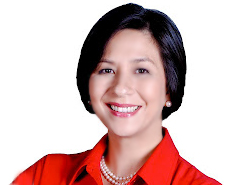
ERLINA U. KOE graduated with degrees in Communication Artsfrom the University of Santo Tomas and the University of the Philippines. She is the first Chairman Emeritus of AutismSociety Philippines, after serving an unprecedented three consecutive terms (2004 to 2009) of trail-blazing leadership as the National President. She writes the column "Autism AngelsTalk" in the Manila Bulletin’s Education section. A much sought-after speaker who travels tomany parts of the country Sharing Hopes and Building Dreams with familiesliving with autism, Mama Dang is the recipient of UST’s 2009 The Outstanding Thomasian Alumni Award for Humanitarian Service for her autism advocacy work. Now a widow, Mama Dang juggles her time forher advocacy, her corporate job as Vice President for Enterprise Core Servicesof Armadillo Holdings, Inc., and her three teen-aged sons - including Gio, now18, who propels her to be passionatewith autism advocacy.

Our Panelists

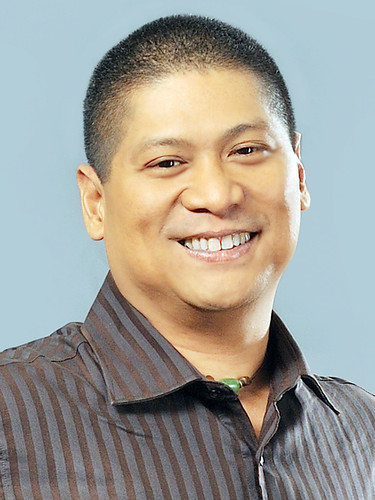
NOBY CABAÑERO is agraduate of Business Administration University of the Philippines. He completed his graduate studies in businessat the Asian Institute of Management. Asa bank executive, he has held various management roles in ABN AMRO Bank,Citibank, Urbancorp Investments, Far East Bank and Trust Company, GuocoSecurities and International Corporate Bank.

PINKY CUAYCONG is a homemaker who gave up a promising medical career for three men in herlife. She is the wife to Anthony, the President of Business World Publishing Inc., and the mother to two teenage sons, Alex and Alphonse. She is a writer,former columnist, blogger and a staunch autism advocate. She has taken on the role of primary caregiver since Alphonse was diagnosed some 15-1/2 years ago. For Pinky, therule "when going out into the world, hold hands and stick together"best describes her family's journey with autism.

ROSANNA ESCAREAL-VELASCO is a certified public accountant, with a degree from the De la Salle University. A financial professional, she has heldvarious management positions in Inteleconsult Corp, Corporate Achievers Institute, Powerpoint Integrated Corp, Maschinen and Technik Inc, Electro International Inc, A Garcia Jr. Securities Corp, among others. She is a candidate for a Masters in Special Education from De La Salle University.

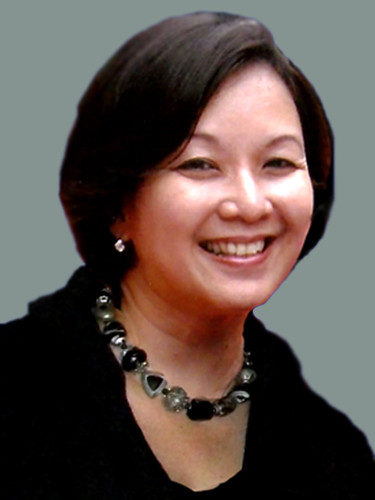
MONA MAGNO-VELUZ is a graduate of Business Administration University of the Philippines. She continued with further studies in Applied Business Economics and Strategic Marketing at the University of Asia and the Pacific and the London School of Business. As a practicing marketing communications professional, she has held various global management roles in Ericsson Telecommunications, Telus International and Emerson Network Power. Mona is a wife and a mom to three kids. Her eldest is 19-year old PWA Carl, whom she has been working with to establish his budding entrepreneurial venture "Gregarious Gifts". As an ASP member, she had taken her autism rights advocacy into the social media arena by blogging and tweeting about her many adventures as "Mighty Magulang".
ELIZABETH B. UDQUIN is a graduate of Clinical Psychology at the Polytechnic University of the Philippines. She is mother to two children on the spectrum, Cholo and Tristan. Stories on Elizabeth and her family have appeared on Manila Bulletin and UNTV Channel 37. She has inspired others with her experience as a parent in various autism awareness talks and seminars.


*****

A special registration rate is available for a group of five (5) participants plus 1 FREE seat. Registrants may pay by depositing the payment to Autism Society Philippines, Metro Bank-Kamias Branch, Savings Account No.047-3-04751874-2. Kindly fax to 7-903-5496 or email to the address below the deposit slip with the name/s of the participant/s. Click here for online registration.

For more information of the conference, you may call us at 7-903-5496, mobile numbers (0917) 556-2075 / (0923) 638-3771 or email aspnc2012@gmail.com.

16 April 2012

Silver Linings

By Pinky O. Cuaycong

A friend asked me last night, “How does that make you feel?” referring to the fragile relationship I have with Alphonse these days. I had to pause and think of an answer. I haven’t been asked that question in a long while, so concerned are we all about Alphonse that no one ever bothers to ask how each of us feels anymore.

Savage Chickens poster

I told her I was sad but at the end of the day, it wasn’t about me, it was still all about him- Alphonse. Because no matter how hard we try to NOT make him the center of our lives, he IS. And it isn’t because we choose to. It isn’t because we’re masochistic martyrs who need the drama in our lives. It’s because he NEEDS us to. There is no one else but us. If somehow, by some strange twist of fate, he gravitates towards the periphery of our family’s life, if he becomes less important than he is now, then who else will be there for him? No one. Sad but true.

The truth is, I am still mourning over the ways my relationship with Alphonse has changed. I no longer have 100% participation in his daily life and it is not because of lack of trying. The many times I have tried to insinuate myself in his daily life, he would lash out at me with violence and anger after an initially very positive response. It’s a special kind of anger he reserves solely for me, and not for anyone else. Certainly not for his nannies who have become the orbiting satellites of his existence today, and if only for that, I am still deeply grateful. I cannot bear the thought of him hurting anyone else.

Then too, my presence creates more work for them, as they end up mopping after the emotional wreckage that Alphonse becomes after days with me. They are the ones who have to calm him down, who have to help him process this rage and let it go. Me, I feel like a puppeteer most of the times. I hold the strings that move our lives, but these strings also keep me always an arm’s length away from him.

As sad as I am over these changes, I do understand that he will have to move away from me to grow. If I allow Alex, my eldest boy, his freedom to be who he is without me hovering like a helicopter parent, then I must accept that Alphonse, by virtue of his age and size, requires that same kind of freedom from me. It’s a difficult and tricky slope to maneuver, balancing his special needs (of which he requires almost 24/7 supervision) with his desire to become an individual separate from me.

Still, there is no time to wallow in self pity. Battle scarred as we all are now, we’ve learned to seize opportunities when they do come. The early mornings when he wakes up and there’s just the two of us around, those are mine, all mine. That’s when I still sense the special closeness that existed between us all these years. That’s when he recognizes me as Mamam and calls me such. I cling to these moments fiercely, guarding them as my precious, albeit, tenuous links to my baby, now almost all grown.

When the clouds are forever hiding the sun, you learn to squint your eyes and look hard for the silver lining. And true enough, by God’s mercy, they are always there.

*****

Pinky Cuaycong is Kittymama, full time mom of two boys (a 19-year-old college student and a 17-year-old with profound autism), part-time writer, and blogger. In Okasaneko Chronicles, she writes about her life’s deepest passions: her husband of 21years, her teenage sons, autism advocacy, and Hello Kitty.

Catch Pinky Cuaycong as she shares her Family's Journey, together with other parents in ASP's 12th National Conference "Living with Autism: Hope at Home". For more information, click here and to register, click here.

*****

Hurry! Only 1 day left to avail the Early Bird Rate and Group Promo for the 12th National and 2nd Southeast Asian Conference on Autism. For a group of 5 registrants, 1 additional seat is FREE.

Registrants may pay by depositing the payment to Autism Society Philippines, Metro Bank-Kamias Branch, Savings Account No. 047-3-04751874-2. Kindly fax to 7-903-5496 or email to the address below the deposit slip with the name/s of the participant/s.

To know more, you may call us at 7-903-5496 or email us at aspnc2012@gmail.com.

World Renowned Autism Experts Speakers at ASP's 12th National Conference

ASP is proud to present world renowned autism experts for the upcoming 12th National Conference and 2nd Southeast Asian Conference on Autism on April 28 and 29, 2012, with the theme "LIVING WITH AUTISM: Hope@Home" at Crowne Plaza Manila Galleria, Ortigas Ave. corner ADB Avenue, Quezon City.

TEMPLE GRANDIN, PHD
At Home with Temple Grandin

Dr. Temple Grandin
A professor of Animal Science at the Colorado State University, Dr. Temple Grandin is considered one of the most accomplished and well-known adults with autism in the world. Diagnosed with autism in 1950, she faced educational, social and professional roadblocks head on and turned her unique talents into a successful career as an author, lecturer and pioneering advocate for autism spectrum disorder education and into revolutionary work in the cattle industry. Dr. Grandin tells her story of "groping her way from the far side of darkness" in her book “Emergence: Labelled Autistic”, a book which stunned the world because, until its publication, many assumed that autism was a hindrance to achievement and to productivity in life. A 2010 made-for-television film about her life starred Claire Danes and won critical acclaim from award-giving bodies. Dr. Grandin was featured in major television programs all over the world, and has also been published in many journals. She has been honored as one of Time’s 100 most influential people.

STEPHEN SHORE, EDD
I Am... I Advocate

Mr. Stephen Shore
Diagnosed with "atypical development and strong autistic tendencies" and "too sick" for outpatient treatment, Stephen Shore was once recommended for institutionalization. As a child, he was non-verbal until he was four years old. With support from his parents, teachers, and family members, Dr. Shore is now a professor at Adelphi University, where his research focuses on matching best practice to the needs of people with autism. He is the President Emeritus of the Asperger’s Association of New England, and a former board member of the Autism Society. He now serves in the Inter-Agency Autism Coordinating Committee, the Asperger’s Syndrome and High Functioning Autism Association, the United States Autism and Asperger’s Alliance, and other autism related organizations.

Only a few days to go. Hurry! Register now for the conference! Click here. Email us at aspnc2012@gmail.com or call us at 7-903-5496 for more information.

In His Own Alternative World

By Dang Koe, ASP Chair Emeritus

Mr. Stephen Shore
Diagnosed with “atypical development and strong autistic tendencies” and “too sick” for outpatient treatment, Stephen Shore was once recommended for institutionalization.

As a child, he was non-verbal until he was four years old. With support from his parents, teachers, and family members, Dr. Shore is now a professor at Adelphi University, where his research focuses on matching best practice to the needs of people with autism.

He is a self-advocate, being the president emeritus of the Asperger’s Association of New England, and a former board member of the Autism Society of America. He now serves in the Inter-Agency Autism Coordinating Committee, and other autism related organizations.

In the Philippines, self-advocacy for persons with autism has started, and this will be tackled by Dr. Shore through an interactive web discussion during Autism Society Philippines’ 12th National Conference on Autism come April 28-29.

A Filipino autism self-advocate, David Michael Lopez (aka Kitt Lopez), interviewed Dr. Shore online. Kitt is a graduate of Bachelor of Arts in Communication from the Lyceum Institute of Technology in Calamba City. He currently works in ASP Laguna’s Autism Resource Center and regularly contributes articles to his chapter’s newsletter.

Here, Kitt interviews Dr. Shore:

Mr. David Michael Lopez
David Michael Lopez

When did you first know that you have autism and how did you react when you found out?

I probably first became aware of having autism at about five and a half. By then my speech had pretty much normalized and my parents used the word autism in the house in regular conversations. It was not something that was hidden from me. As a result, I had an explanation as to why things were different for me. I think it is important for people who have autism to know about having it as soon as reasonably possible.

Describe autism in your own words.

Autism is a different way of being and perceiving the world. It is not necessarily good or bad. However, there is a lot of good that can be done by working with the characteristics and strengths a person with autism does have. For example, a person with a deep interest in astronomy can be taught mathematics through counting planets or measure distances between objects in space.

What did “bad behavior” mean to you during adolescent days?

“Bad behavior” meant doing things that your parents and teachers did not want you to do such as being rude and not cleaning one’s room. The usual societal rules governed what bad behavior was for me.

Having autism is not an excuse for engaging in bad behavior, but rather a pathway to understanding how to educate the individual in what is good behavior. However, for those with autism, it’s important to teach them in a way they can understand what bad behavior is and how to avoid engaging in such actions.

Being autistic means that you are living in your own world. How did you control your negative emotions such as inappropriate laughing, lack of eye contact, and becoming lonely?

Rather than living in my own world I consider myself as living in an alternative world where things had different meanings for me than for others.

Additionally, I just had different interests than my classmates. As a result I sought out avenues to engage in my interests. For example, for my interest in classical music, I joined a community orchestra. To satisfy my interest in bicycles, I joined community organizations that sponsored bicycle rides in the areas. These examples suggest that it’s possible to find friends and people with similar interests outside of the school setting.

As for being in this world or not, I like to think that I am very much in this world but just tuned to different aspects of it.

As a professor, how do you teach your students the good values?

My goal is to educate my students that people with autism are not necessarily disordered but rather of a different order. Through hands-on simulation activities I try to give my students a sense of what it might be like to have autism. Doing so helps to dismiss the many myths of autism.

One such myth is that people with autism don’t like to socialize. What I have found in talking with many of my colleagues is that they wish to interact with others. However, after so many bad experiences with trying to interact turning out badly, they just give up – as anyone else might.

How will I eventually land a permanent job? Please give me tips.

The best route to employment is through following one’s strengths and interests. Sometimes these interests will need a little molding or direction towards something that can be translated into fulfilling and productive employment. For example, as a child I had a strong interest in bicycles. So strong, that I taught myself to build a bicycle from the ball bearings and spokes to completion. That interest was eventually parleyed into where I at first worked as a bicycle mechanic, and then, running my own bicycle shop to pay for college tuition.

My interests in music led to my working as a professor of music for five years. My fascination with autism has led to my current position as a professor of special education at Adelphi University.

In short, follow your strengths and interests for they may make you an expert in that area beyond anyone else.

What is the strongest message you can bring to persons with autism?

The most important message is that the potential of people with autism is unlimited — just as it is the same as everyone else. Our challenge is to figure out how to access that potential to empower the individual with autism to lead a fulfilling and productive life.

*****

Catch Dr. Stephen Shore and Dr. Temple Grandin, another world autism hero, on interactive web discussion during ASP’s conference on “Living With Autism (Hope@Home), April 28-29, Crowne Plaza Hotel. For details, please email aspnc2012@gmail.com

This article was first published in the print and on-line versions of the Manila Bulletin.

14 April 2012

ASP Family Support Group for April 2012

Share your HOPES and DREAMS with us. We will listen.

Perlita "Peng" So has been serving as ASP's Vice President for the last two and a half years. Peng wears many hats. She juggles between being a full-time hands-on-mom to her two gems on the spectrum, Patrick and Angelo; while empowering her other adult children in handling the family business together with her husband. On top of that, she never fails to whet our appetites with her culinary expertise and her practical up-to-date fashion advisories.
Momie Peng with sons Patrick and Angelo

Patrick, 21 years old, is now a BS Life Science Senior at the Ateneo de Manila University. He is a celebrated science and math wizard and currently works part-time as an intern in a veterinary pharmaceutical company. His younger brother Angelo, 14 years old, is a USSEP student at Community of Learners Foundation Inc.

Raising autism awareness is part of her daily agenda, as she is also vital in advocating for inclusion of Patrick in the Ateneo de Manila University. She also mentors new ASP chapters located near her home town, Pampanga; among the other demanding duties and responsibilities of being a Vice President. She inspires other families to defy logic and go beyond the autism diagnosis.

Find out Peng's secret weapon!

Sign up now for the next Family Support Group. Only 15 seats available! Call now at 7-903-5496

Date: April 21, 2012, Saturday
Time: 1:00-5:00PM
Venue: ASP Office, Room 307,
ML Bldg., #47 Kamias Road, Quezon City

Crowne of Hope

ASP representatives visited Crowne Plaza Galleria Manila for an ocular inspection and some final arrangements for the upcoming 12th National and 2nd Southeast Asian Conference on Autism "Living with Autism: Hope@Home", slated on April 28-29, 2012.
Living with Autism Hope@Home poster

Ms. Cecile Sicam, Conference Chairperson, and JR Tan, conference guest speaker, presented posters to Ms. Ching De Castro, the hotel's Meetings Manager. The posters aim to help promote autism awareness and inform patrons about the upcoming confab. Joining them were Evelyn Go (ASP-National Treasurer) and Tiffany Tan (ASP-National Secretary).

Hurry! Only 3 days left to avail the Early Bird Rate and Group Promo for the 12th National and 2nd Southeast Asian Conference on Autism. For a group of 5 registrants, 1 additional seat is FREE.

Registrants may pay by depositing the payment to Autism Society Philippines, Metro Bank-Kamias Branch, Savings Account No. 047-3-04751874-2. Kindly fax to 7-903-5496 or email to the address below the deposit slip with the name/s of the participant/s.

To know more, you may call us at 7-903-5496 or email us at aspnc2012@gmail.com.

10 April 2012

PWDs invisible even to human rights advocates

By Carlo Figueroa, VERA Files

CAN one marginalized group be more marginalized than the others?

Yes, say persons with disabilities (PWDs) who live with this assumption every day. Indeed, a report by the Coalition on the U.N. Convention on the Rights of Persons with Disabilities (PhilCoalitionCRPD) says that among vulnerable groups—women, youth, gays and lesbians, and indigenous peoples—PWDs get the least attention from government and sadly, even from human rights campaigners.

Leslie Lomongo, a person with cerebral palsy,
sits in his wheelchair waiting for his ride home.
Photo by Mario.

"Throughout the years, persons with disabilities have remained largely invisible because of discrimination," said PhilCoalitionCRPD in its report submitted to the United Nations Human Rights Council (UNHRC).

The document is part of the joint civil society report submitted for the UNHRC's Universal Periodic Review (UPR) conducted every four years to look at the human rights situations of the U.N. member countries. The Philippines will undergo its review in May.

"Unfortunately, there was no discussion on persons with disabilities in the Philippines' state report for the UPR in 2008," Dr. Liza Martinez, director of the Philippine Deaf Resource Center and a member of the PhilCoalition CPRD said in a recent briefing held in Makati City in preparation for the UPR.

"When will this veil be lifted?" she asked, referring to the lack of attention given to PWD issues even within international discussions on human rights. "The fact that there is no mention of any disability rights, nor any participation by the sector in the first UPR is clearly evidence of this," the coalition's statement added.

Martinez and her group are hoping that the response to her question would come sooner through their recommendations given to the UNHRC.

The coalition is recommending that the Philippines ratify the Optional Protocol to the U.N. Convention on the Rights of Persons with Disabilities (UNCRPD). Though the Philippines signed the convention in 2007, it has yet to ratify the optional protocol.

The convention is an international treaty that obliges signatory states to promote and protect the rights of PWDs. It also establishes a special committee in the U.N. to monitor the implementation of the agreement. The optional protocol meanwhile sets procedures to carry out the provisions of the convention including mechanisms on how to file charges and complaints of violations before the committee, and giving the committee the authority to organize inquiries to investigate allegations.

The second recommendation is for the government to do a comprehensive review of policies that may be discriminatory "on the basis of disability." The coalition's report said that there has been no effort to harmonize local laws with the UNCRPD.

The report identified policies that do not recognize PWDs as legally competent: In several articles of the Civil Code, in the Rules of Court, and policies concerning guardianship, and the appropriation for programs and activities for PWDs.

"Exclusion and discriminatory practices have been so rampant and have existed for such a long time that it has covered the entire sector with a shroud of invisibility which has to date been very difficult to overcome," the report admitted.

To be fair, the coalition also named social protection mechanisms for PWDs: Disability benefits, PhilHealth insurance, and a 20 percent discount on medicine, transportation, and medical services. But the group pointed out that these are insufficient and actually unfair. Only PWDs who are employed enjoy disability benefits, and since a majority of them are unemployed, they are not eligible for these benefits.

"Since many of them are also poor, they would not even have the minimum capacity to purchase medicine, medical services, etc. in the first place so that they can avail of the 20 percent discount. This 20 percent discount is not available in areas where there are no establishments mandated to provide such discounts. Also, labor market programs for persons with disabilities have not been systematic enough to have a significant impact," the report said.

The absence of updated data that provides basic information such as the latest statistics of PWDs is also problematic. "There is a dire lack of documentation for even the most fundamental information about Filipinos with disabilities," the report said.

The last available report made by the National Statistics Office in 2005 was based on the national census conducted five years earlier in 2000. Based on the results of that census, there were more than 942,000 people with disabilities or about 1.23 percent of the country's total population at that time.

Blindness, deafness, paralysis, and mental retardation or mental illness were the four most common impairments. This lack of recent statistics poses a challenge as policymakers rely on these numbers to justify appropriations for programs and services for what is considered a vulnerable sector.

VERA Files is put out by veteran journalists taking a deeper look at current issues. VERA is Latin for true. Via Yahoo News.

*****

ASP is a member of the Philippine Coalition of UNCRPD.

Be an Autism Angel. Donate generously to Autism Society Philippines. Donations can be deposited to Metrobank Kamias Branch 047-3-04751874-2. Email us at autismphils@gmail.com or call 7-903-5496 for more information.

09 April 2012

World Autism Hero Goes Online For Filipinos

By Dang U. Koe, ASP Chair Emeritus

Dr. Temple Grandin
Temple Grandin is listed in the 2010 Time 100 list of the 100 most influential people in the world in the category “Heroes.”

As a person with high functioning autism, Temple is an autism icon worldwide, noted for her work in autism advocacy who invented the squeeze machine designed to calm hypersensitive people.

Grandin is also a doctor of animal science and professor at Colorado State University, bestselling author, and consultant to the livestock industry on animal behavior.

Temple Grandin will be gracing, via an interactive online presentation, Autism Society Philippines’ 12th National and 2nd Southeast Asian Autism Conference on April 28-29. It will be the first time for Temple Grandin to face, albeit via online, a Philippine conference.

Maria Angela "Yanna" Aragon
n August last year, HBO Asia showed the Emmy-award winning biopic “Temple Grandin”. Angels Talk looked for a “Pinay Temple Grandin” for a movie review. We found Maria Angela “Yanna” Aragon, 21, currently working as a subcontractor coordinator at IBM Global Process Services.

For this week’s Angels Talk, we asked Yanna to interview Temple Grandin online, while sharing her own story.


*****

I’ve watched your biopic Temple Grandin and read your book ‘Thinking in Pictures’, and— as you, your mother, and your aunt are the only individuals in your family given focus — I’ve always wondered how was your relationship with your father or siblings, if you have any?

I had three siblings. Having an older weird sister in the same school was difficult for my sister who was close to my age.

When my family found out I was special, initially it came as a surprise. Dad wanted to stop working and just take up Special Studies at UP so he can better assist. Mom practically blamed herself. She thought that maybe she didn’t take care of me while I was still in her tummy. How did your family react when they found out about your being autistic, especially after you were diagnosed?

My father had difficulty accepting an autistic child. Mother was my supporter and protector. I get along really well with my siblings and see them every Christmas. We live at opposite ends of the country.

They say most persons with autism are averse to physical affection. My mom said when my sister and I were still young, we were both very close to our yaya (nanny). It was hard to take us away from her. Every chance my parents get, they would carry me.

Eventually, I began to get used to, even like, the feeling of being hugged, kissed, etc--thanks to family and most of my friends. However, there were times that I’d still feel uncomfortable with giving and receiving physical contact (e.g. when coming from people who are too touchy-feely, from strangers) How were you able to display affection towards members of your family?

Temple: All the answers to this question are in my book “Thinking in Pictures”.

I usually explain to people that children with autism are special. They are affectionate in their own way but they need a greater degree of understanding and patience.

How can autism be explained to children, in a way that doesn’t lead to bullying or negative impressions?

Autism is a broad spectrum ranging from geniuses such as Einstein to very severe. Mozart probably had mild autism.

My parents said we didn’t have to explain autism much to our relatives. They knew I was special. But whenever I exhibited inappropriate behavior, my parents had to call my attention and later explain it to me a bit about behavioral issues. How did your parents explain autism to any young relatives you have?

She explained that I had a brain handicap that was not visible like a wheelchair.

What can you advise to families of those with autism, especially to those who either rely too much on institutions, or on themselves, in order to get them to work together to help the member with autism?

Families need to get together to support each other and create local support groups. Parents need to support and counsel other parents.

This article first appeared in the print and online versions of the Manila Bulletin.

*****

Aside from Temple Grandin, another autism self-advocate, Dr. Stephen Shore, will be online for the 12th National and 2nd Southeast Asian Conference on Autism, April 28-29, at Crowne Plaza. The conference, titled “Living with Autism (Hope@Home)” will also feature local autism experts like Dr. Alexis Reyes, and actual experiences of Filipino families. For more details, please email aspnc2012@gmail.com or follow us on Facebook.

 
Design by Free WordPress Themes | Bloggerized by Lasantha - Premium Blogger Themes | Sweet Tomatoes Printable Coupons