The Autism Society Philippines (ASP) is a national, non-profit organization dedicated to the well-being of persons on the autism spectrum disorder. We envision a society where Filipinos on the spectrum become the best of their potentials -- self-reliant, independent, productive, socially-accepted citizens of an Autism-OK Philippines.

30 June 2012

ASP joins the Freedom Walk

By Cathy Genovia, ASP Program Assistant.

True to its stature as the most active parent support organization, ASP joined the Freedom Walk for the second time last 02 June 2012 at the Quezon Memorial Circle, together with more than 1,000 participants coming from the different local government units in Mega Manila, from the national government agencies and from the disabled people’s organizations.
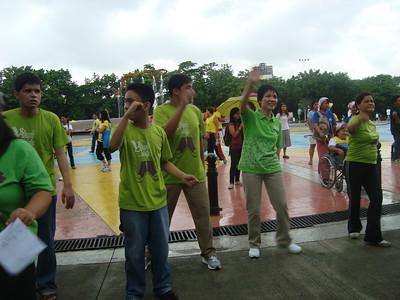
ASP National President, Jan Pena (2nd from right) and ASP Lagro Chapter President, Marieta Tan (R) during the warm up exercise.

The event which was part of the early Independence Day celebration of Persons with Disabilities (PWDs) adopted the theme “Each Right- Full Step We Take, All Barriers We Break.” The sector kept true with their theme -- braving the heavy downpour that began at dawn of the event day. Collective prayers were answered as the sun peeked from behind the gray could right before the program proper started.

Newly-elected National President, Mary Janette Peña led the contingent of ASP with Muneer, her adolescent son with autism and representatives from ASP Chapters from Commonwealth, Lagro, Proj. 4, Cubao, Quezon City. The National Office and its chapters came, proudly bearing their banners. ASP Angels from the National Office, Abby, Cath and Ien, were also present to assist the participants and also to lend a hand to the National Working Committee of which ASP is a member.

The walk’s working committee, headed by Mr. Emer Rojas of New Vois and Capt. Oscar Taleon of AKAP-Pinoy, would like to express its heartfelt gratitude to all the sponsors, supporters and participants for the event’s success. Proceeds from the event help sustain the advocacy program of AKAP-Pinoy, geared towards the realization of the provisions of the United Nations Convention on the Rights of Persons with Disabilities (UNCRPD).

29 June 2012

"Living with Autism: Hope @ Home" -- an echo conference

At the heels of the success of the the recent 12th National and 2nd Asian Conference on Autism with the theme “Living with Autism: Hope@Home’ held last 28-29 April 2012 at the Crown Plaza Manila Galleria, the Cavite Chapters of the ASP is bringing the same enriching conference topics to South Luzon.

The ASP Cavite Chapters, in partnership with St. Brother Miguel Febres Cordero Neurodevelopmental Center of De La Salle - Health Sciences Institute and the Local Government of Carmona, Cavite will be holding an echo-conference “Living with Autism: Hope@Home” – the Fifth Regional Conference on Autism (the Second CALABARZON Conference on Autism) on 11-12 August 2012. The target audience for this conference are parents, professionals, students and local government officials and representatives from Region 4A and NCR.

Day 1 will highlight Community-Based Rehabilitation (CBR) Best Practices and Sites of the Municipality of Carmona to present a recognized model for PWD program, particularly for autism, to all LGU’s in Cavite and Region 4A. This will be hosted by San Lazaro Business and Leisure Park in Carmona, Cavite through the partnership of Mayor Dahlia Loyola and the Manila Jockey Club, Inc.

Day 2, which will feature salient topics on family and community approaches in addressing autism, will be hosted by the De La Salle Neurodevelopmental Center at Villarosa Hall Angelo King Bldg., De La Salle Health Sciences Institute, Dasmarinas City.

For us, Home is not only Family. Home is our Community. Home is our Town, Our Province, our Region. Let us elevate our aspirations for our children with autism beyond family. Let us make ready for them a wider haven that will nurture their minds and capabilities towards more productive and meaningful life! Let’s keep up with Hope@Home!

Registration Fees
Pre-registration until July 31, 2012
Adults, ASP Members .............. P1,500
Adults, Non-ASP ..................... P2,000
Students, ASP Members ........... P1,000
Students, Non-ASP Members ... P1,200
Siblings ..................................... P1,000

On-site Registration
Adults, ASP Members .............. P1,700
Adults, Non-ASP ..................... P2,200
Students, ASP Members ........... P1,200
Students, Non-ASP Members ... P1,400

The conference fee includes Seminar Kit with CD, Certificate, AM/PM Snacks and Lunch for two (2) days. Participants from NCR and other provinces will be limited to 50 lots. For more information and inquiries contact Chie Marquez of ASP Bacoor at (0917) 540-6727.

28 June 2012

"Different But Not Less"

By Josephine Palomares, ASP Diliman Chapter President.
Different But Not Less poster

Macky was born pre-mature at eight months old as my doctor has to ‘cut me up’ because I was having pre-eclampsia (hypertension). He was a healthy baby and my first-born at age 34.

When he was two and a half, during a family outing at a theme park, he was so hyperactive – running around the park uncontrollably. He spent the whole day running and staring at anything that moves around. My sister told me to have him checked because he seems ‘weird’. He was non-verbal (old folks would tell you that maybe he is just ‘delayed’ as most boys are) and seemed deaf; did not have eye-contact; and would watch TV sideways.

What could be wrong with him? We brought him to a hospital to have his ear checked. His hearing was ok.

On our first visit to a Developmental Pediatrician, the diagnosis was autism and it was to be a lifelong condition. Of course we did not believe her and continued our rounds of several pediatricians, psychiatrist and psychologist. It was to be the most stressful year of my life.

Several questions arose as to what could have caused it. Is it during my pregnancy? Was it my fault that he was born that way? What did I do? Have I not been a good mother?

Finally my husband and I decided to face it head-on. We gave him all the therapies he needed; but we resolved never to treat him ‘special’. At six years old, Macky is still non-verbal. His speech therapies continued till last year because his therapist had to leave.

I read all I could find out about autism and I joined ASP (Autism Society Philippines) and became an active member. I advocated for my son and joined their activities. At ASP, I found out that there are other kids that have multiple disabilities (co-morbid condition with autism). I met Moms who would later inspire me and change my perspective on autism. I realized I am not alone. I was thankful; and counted my blessings.

Macky is now 13 yrs old and highly-functional. He attends a regular school and is fully-included. He is now verbal and plays the piano. He is just like any regular teenager except that he still has some ‘odd’ mannerisms like jumping when excited and looking sideways.

I wish that Macky will be happy and will go about life without so much pain and difficulty. That he will find work and have friends. I hope that when Macky becomes an adult, our society will be more accepting and tolerant of people like them.

“For they may be different, but not less” (quote from Temple Grandin).

*****

A Special Place is the flagship project of the Association for Adults with Autism Philippines (AAAP), a non-profit group conceived and established by parents of persons with autism. The association aims to provide sustained enrichment opportunities and long-term care to these individuals as well as offer means to achieve personal growth, social interaction, and a cooperative life among their peers.

*****

This article first appeared in the print and online version of the Manila Bulletin on 25 June 2012.

27 June 2012

Alyana showing in Marikina

ASP Marikina Alyana poster

Autism Society Philippines Marikina Valley Chapter headed by Alex Cabason Jr., in cooperation with the City Government of Marikina will be bringing Alyana to Marikina City on 14 July 2012 at 2 pm at the Teatro Marikina along Shoe Avenue, Marikina City.

“Alyana -- A Study of Autism in the Philippines” is the first documentary film on autism in the Philippines by independent film maker, Miranamedina. The film has been showing all through-out the Philippines, in cooperation with ASP Chapters since 2006. The trailblazing film was screened at the Cinemanila International Film Festival in November 2006 and at the 3rd Festival on the Issues Concerning the Mentally Challenged in New Delhi.

For more information regarding the Marikina film showing, you may get in touch with Marivi at (0949) 398-3672 or Tonette at (02) 381-5448.

*****

To request for a showing of “Alyana” in your area, please email autismphils@gmail.com. Or call 7-903-5496 for more information. Contribute to ASP Programs and Services -- donate to Autism Society Philippines, Metrobank Kamias Branch Account No: SA 047-3-04751874-2.

26 June 2012

Iconic AutiSM Moments at SM MOA Arena

By Tiffany Tan, ASP Correspondent

The Philippines’ newest ultra-modern sports and entertainment facility, the SM Mall of Asia Arena, rolled out the red carpet, once again, to the Autism Society Philippines. ASP representatives were treated to the grand launch of the SM Arena, dubbed “Icons,” a two-hour concert featuring the Philippines’ top OPM singers, last 16 June 2012 at 08:00 pm.

ASP Family watching Iconic AutiSM Moments

Mr. Henry Sy, founder of SM Group and chairman of SM Prime Holdings, also 2012 Forbes Magazine’s richest Filipino, with US$9.1Billion to his credit, was honored on this special occasion. Mr. Hans Sy, President of SM Prime Holdings, Inc. paid tribute to his father’s legacy during his address.

Filipino artists, who have helped raised funds for ASP and persons with autism in the past, like Lea Salonga, Martin Nievera and Pops Fernandez and Christian Bautista, led other eminent songsters to serenade an audience nearly 20,000 strong.

Days before the launch, ASP Trustee Peng So, gave an Autism Orientation to some 200 new personnel of SM MOA Arena on 14 June 2012. Eng. Bien Mateo, Director of SM Program for Disability Affairs (SM-PDA) ensured that SM-PDA will continue working towards a barrier-free and non-handicapping environment for persons with autism and their families.

Cecile Sicam (Vice President), Evelyn Go (Treasurer), Trustees Grace Adviento with husband Glen; Trustee Gina Bermudo with husband Lito; Trustees Carmel Almendrala and Peng So and former Trustee Barbara Lu and this author; plus ASP UP CAMP Chapter Secretary, Jeng Rodriguez and husband Romeo were joined by their children (both with autism and neuro-typicals) and their care givers. Trustee Ging Viado rubbed elbows with soap opera star and celebrity chefs, Janice de Belen and Marvin Agustin. The evening of music also turned out to be a fitting Fathers' Day celebration for the spouses of Trustees!

Children with autism are said to have sensory issues, but that night was a big surprise to the parents who were amazed at the sight of PWAs waving their lighted multi-colored battery operated torches. Gelo enjoyed waving the glowing torch; Angelo swayed to the infectious music; while Bryan sang-along as the OPM crooners and divas delivered their vocal symphonies.

Indeed it was an Iconic AutiSM moment for all of us and we look forward to more AutiSM partnerships in the future, perhaps the upcoming Cirque the Soliel in July?

ASP thanks SM-PDA's Eng. Bien Mateo for his generous invitation and complimentary tickets and to former Trustee Barbara Lu for kindly providing transportation to the representatives.

25 June 2012

SM MOA Arena personnel oriented on autism

By Abegail Mendoza, ASP Program Assistant.

True to their vision of making SM a PWD-friendly environment, SM extends its AutiSM partnership from their growing number mall branches to their residential buildings, and now, to the SM Mall of Asia Arena – the country’s latest ultra-modern, world-class sports and entertainment venue.
Trustee Peng So during the SM MOA Arena Orientation

Trustee Peng So gave an Autism Orientation to 200 new personnel at the SM Mall of Asia Cinema Premiere, last 14 June 2012. The orientation is part of SM’s “Handling of Special Customers” Project which aims to prepare the new environment for the special customers.

Other invited speakers were Ms. Agnes Lapeña of the Down Syndrome Association of the Philippines (DSAPI) and Arch. Jaime Silva, a.k.a. the Blind Architect, of the United Architects of the Philippines (UAAP).

With the continuing partnership between ASP and SM Program on Disability Affairs (SM-PDA), headed by Director Eng. Bien Mateo, Peng So said she is now more confident in bringing her two sons with autism to enjoy bonding moments with the family at the SM Mall of Asia Arena. Patrick, who is now a graduating student of Life Science in Ateneo de Manila, can now watch the upcoming UAAP Games; while younger brother Angelo, will come for future events and concerts. Peng So looks forward to seeing new personnel becoming more equipped in addressing unique and special customers.

ASP extends a special thanks to SM-PDA Director, Engr. Bien Mateo, and SM Regional Operations Manager, Engr. Rheybie Nipas for their continuous support and partnership.

23 June 2012

ASP joins round table on disability-inclusive finance

ASP Executive Director Ranil Sorongon participated in the round table on Disability-Inclusive Finance, jointly organized by the Asia-Pacific Development Center on Disability (APCD) and The Nippon Foundation (TNF) last 19 June 2012 at the APCD Training Center in Bangkok, Thailand.
The round table on Disability-Inclusive Finance

Selected representatives from persons with disabilities organizations, microfinance institutions, banks and parent support organization coming from the Asia-Pacific participated in the series of discussions on Inclusive Business.

Inclusive Business: Beyond Corporate Social Responsibility (CSR) is an emerging perspective of looking at Persons with Disabilities (PWD) as potential entrepreneurs, employees and customers of business entities. It also promotes the principles and the rights of PWD enshrined in the United Nations Convention on the Rights of Persons with Disabilities (UNCRPD).

The talk on Inclusive Finance provided a platform for the representatives of the banking sector, microfinance groups and PWD to engage in a dialogue to understand each others’ practices and perspectives and look at possible means to forge a win-win relationship in the near future. The exchange also provides a new perspective that PWD can engage in business on an equal footing with people without disabilities, if given opportunities and support.

ASP thanks Mr. Ninomiya, the Executive Director of APCD for inviting ASP to represent the Filipino autism community in regional discussions such as this. As part of ASP’s continued trail-blazing advocacy, Director Sorongon will contact microfinance institutions and banks to pursue opportunities for inclusive financing for entrepreneurs with autism.

22 June 2012

On finesse, fitness and freedom

By Maria Angela “Yanna” Aragon.

PWA Yanna, the author (third from left), Vicente Rubio (in shorts) and seminar organizers.

An SMS was sent to me by Perlita So the day before the back-to-back seminars’ (“Autism, Health, and Well-Being”, and “Autism and Mentoring Life Skills through the Ages”) were to have their first run, asking if I would be interested in attending. My interest was piqued after going through what was written in the attached promotional brochure. After informing Tita Peng of my intent to attend both sessions, and listening and having the chance to talk to Ron Vicente Rubio (the speaker), I was thankful that I received that text message.

I had the chance to talk to Mr. Rubio as soon as I entered one of Quality Life Discoveries’ activity rooms, where the seminar was held. While in conversation, I didn’t notice anything that gave away his being diagnosed with Asperger’s Syndrome. Then again, he mentioned the same of me. From what I remember, he was specifically talking about how I carried myself -- perhaps my body language?

Once the first session began, and the Powerpoint slides were being flashed on screen, I was surprised to find out that autism incidence -- in the US, at least -- was on the rise. Even more so when the session turned into a mix between an etiquette and a fitness class, as we were taught how to properly sit, stand, and breathe -- not that I complained. On the contrary, I enjoyed being able to move a bit instead of sitting all throughout the session. The second session was more of a summary of the issues plaguing people at certain stages of their lives, supplemented with stories of the speaker’s experiences of mentoring various individuals. I was a bit disappointed that most, if not all, of the information mentioned by the speaker were in the context of the United States. As he had grown up there all his life, it’s understandable though.

The most interesting part of the seminars came during the Q&A after the second session—when it turned into a mini-demonstration of how to use some martial arts techniques to subdue and disarm a potential attack. For those wondering how this came about, one of the participants asked how they can subdue students with violent tendencies.

However, the most insightful part of the seminar came near the end, when Mr. Rubio made mention about two ways by which children of special needs -- perhaps all individuals, now that I think about it -- are made to relate with the world. One way is to pamper and spoil them, protect them from all that is ugly and painful. The other way is to have them fend for themselves, to deal with that which can hurt them, to seek their own survival. At that point, I was reminded of one of the most important lessons I learned in a philosophy class, back when I was in college. It was a lesson on freedom: that freedom is not found in sheltering one’s self from the world -- limiting the choices one made. Freedom is found in the stepping out into the world, where many more choices can be found. Mr. Rubio also talked about letting individuals decide for themselves, and being accountable for their actions.

I then realized: being too overprotective of individuals -- to the point of making decisions for them -- would impair their capability to choose for themselves when they get older. In addition, they might have difficulty moving around in, and contributing to, society. With this, I am reminded of seeds kept inside those packs sold in supermarkets. Though they are in perfect condition, all are useless until they are planted in the real world. On the other hand, exposing a child to the real world entails him getting hurt and having to make decisions for himself from time to time. However, with guidance, all are ways by which the child can mature and be independent—much like the bud that, although exposed to the elements (and with proper care) can grow to become a sturdy and useful plant.

I know that teaching special children to breath, sit, and stand properly may seem silly vis-à-vis giving them the capabilities to be independent, but performing these actions will not only promote good posture; but will also allow them to keep calm and to focus, allowing them to tame their ‘chattering monkeys’ and prevent them from having meltdowns. In addition, having them focus will allow them to be able to make clearer decisions. Combine this with being able to advise and challenge them to live out important life lessons, without spoon feeding; and they will be one step closer to living independent and fulfilling lives.

21 June 2012

Training on early intervention for children with autism and other special needs

The ASP Laguna Chapter will be holding a five half-Saturday trainings on Early Intervention for Children with Autism and other special needs from 07 July to 04 Aug 2012, at the Autism Resource Center at Intan Street, Sta. Fe Subdivision, Batong Malake, Los Baños, Laguna.
Early intervention For Children with Disability Wide

The program will cover the five major topics: Understanding the Child with Special Needs, Introduction to Sensory Information Processing, Understanding and Managing Inappropriate Behavior, Developing Early Communication and Teaching Children with Autism and Other Special Needs.

Please call (049) 536-0655 or text (0939) 240-5970 for fees and other details. Only 10 slots are available, so we encourage early registration.

20 June 2012

Well-being and life skills seminars in Cavite a success

By Gerard Joseph Atienza.

The Autism Society Philippines (ASP) Cavite Chapters, in partnership with the Autism Research Institute and the Municipal Government of General Trias, had successfully held their back-to-back seminar series titled “Autism, Health, and Well Being” and “Autism and Mentoring Life Skills through the Ages” on 13 June 2012 at the Audio-Visual Room, Municipal Hall of General Trias in Cavite.
Speaker Vicente Rubio with participant

Heading the seminar series was Ron Vicente Rubio, Director of Pathfinder Mentoring and Coaching, a US-based center that aims at empowering and guiding individuals with a diverse range of challenges, including the autism spectrum. The seminar series was a part of his tour around the Philippines to raise autism awareness, and in this seminar, it was spearheaded by the ASP National President and Gobernadora of the Cavite Chapters, Tita Jan Peña, who gave the introduction speech.

During the first part, which was held in the morning, Vicente gave a brief background on his life as a Filipino-American who faced a lot of challenges, including his life with Asperger syndrome, with which he was diagnosed on 2010. He also shared theories and issues on autism in the American setting; and compared it with the Filipino setting, which he described as a new and open ground for future development of autism awareness. He discussed ways on promoting wellness and appropriate diet for people with autism (PWA) and ways how PWAs, their parents, and their teachers can deal with daily life.

On the second part of the seminar series, held after lunch, Vicente imparted with the attendees the basics of Mind/Body Techniques, fitness strategies that are outlined in his book Mind/Body Techniques for Asperger’s Syndrome: Way of the Pathfinder. Among those strategies, which Vicente had shared with his students as an instructor of dance and martial arts, include appropriate posture, exercises, and self-defense, among others. In addition, he also discussed the different stages of passage that PWAs happen to pass through, outlining the changes and issues they encounter and the ways how they can overcome said issues.

This seminar was indeed a timely venue for the attendees, who were composed of teachers, parents, professionals, and PWAs, to learn new concepts and techniques on living with autism, and giving opportunities for PWAs to live their lives to the fullest.

19 June 2012

A day with Sensei Vicente

By Ms. Joy Ofrecia, President of City of San Fernando Chapter

ASP CSFP Chapter conducted its first seminar for the year last 14 June 2012 at the University of the Assumption in the City of San Fernando, Pampanga. The seminars "Autism, Health & Well-being" and "Autism and Mentoring Life Skills" were conducted by the resource speaker Mr. Ron Vicente Rubio of the Autism Research Institute. He is a martial artist, professional dancer and a mentor to individuals with Asperger Syndrome. He himself is on the spectrum diagnosed in 2009.
Participants in Rubio seminar

ASP CSFP President Ms. Joy Ofrecia, together with Mr. Ranil Sorongon ASP Executive Director welcomed the participants from the different chapters of ASP namely Malolos Chapter headed by Dra. Anawi Tolentino, Olongapo Chapter representatives, Dr. and Mrs. David Calapatia and members of the host chapter, including the University of the Assumption BEE SPED students.

Mr. Rubio stressed on the importance of seeing every individual as a holistic entity. He pointed out the need to focus on breathing and breath awareness, to use visualization to see the whole self to begin creating energy and making the person anchor his body cognitively and to ground self physically to the earth. These techniques will help develop stamina and endurance, and body confidence as a stepping stone to address challenges. It will also create strategies to maintain progress and self-reliance.

Mr. Rubio also mentioned that breathing settles the mind and that it is necessary to stimulate the mind and body in the present moment and neither in the past nor the future. He also stressed on the importance of a good choice of the food to eat, and a special mention to drinking lots of water, eating lots of green and cutting on sugars and oil. Changes in the diet need not be immediate; he suggests doing it in moderation.

The participants went home bringing with them new information that will help them not only as they teach and manage individuals on the spectrum but also for their own personal improvement.

18 June 2012

Amazing fathers

By Dang U. Koe, ASP Chairman Emeritus.

The world waxes lyrical about heroic fathers in our midst every third Sunday of June — when hand-wrapped gifts of neckties and electronics are prepped, and restaurants are packed.

But no one deserves more praise than the father to children with autism.

“Special dads” may not have the opportunity to play basketball one-on-one or ride a bike with their child, but the unlikelihood of sharing these traditional dad-child passions makes their fatherhood a more deliberate, if not more engaging, adventure.

Our new angel talker is the newly-elected secretary of Autism Society Philippines’ national board of trustees. Mom Mona received degrees in Business Administration, Applied Economics and Strategic Marketing from the University of the Philippines, University of Asia and the Pacific and the London School of Business, respectively. She is a wife and a mom to three kids — her eldest is 19-year old PWA Carl, whom she has been working with over the past two years to establish and to grow his budding entrepreneurial venture “Gregarious Gifts”. As an ASP member, she has taken her autism rights advocacy into the social media arena by blogging and tweeting about her many adventures as “Mighty Magulang”.

******

No doubt, moms have very important roles to play; but many fathers of children with autism have earned their niche by embracing that which comes naturally to them.

The Disciplinarian. Papa Carl has been a strong force in the life of his son with autism, Rupert, 12. He makes Rupert understand why something is wrong in very concrete terms like cause and effect — sometime through skits!

When tensions arise, Carl speaks in a calm voice, careful not to aggravate the situation. In parties and family gatherings, Carl stays close to Rupert and introduces him to relatives, includes Rupert in the conversation and reels him in when the child is tempted to act out. The calm sternness and yes, the physical strength of men, are ideal when children need to be managed into staying still or acting appropriately in social situations.

The Teacher. Gabriel, a nine-year-old boy with autism, has not yet discovered speech; but Daddy Glenn has made this the very reason to spend every spare minute with him. Glenn attends to Gabriel’s every need and has discovered a special bonding activity both of them enjoy — building model airplanes. Engaging in objective-driven tasks help address the physical or behavioral deficits of a child is important. The ability of the parents to tandem and to share these tasks ensure continuous exercise towards mastery.

The Friend. Daddy Rhene loves playing with his son with autism, Calvin, 6. Considering Calvin’s difficulty in making friends, Rhene is very hands-on and has become his no. 1 playmate. Considering communication and social skills is a recognized weakness in children with autism, playing with your child teaches them rules of play and social graces which will be increasingly important as they age.

The Mentor. Vicente Rubio, director of Pathfinder Mentoring, stressed the importance of early mentoring in young individuals with autism, in his seminars on “Autism and Mentoring Life Skills Through the Ages” held in the Philippines this month. Fathers are often the brains behind the rites of passage — an important milestone to make children understand that they are growing up. As simple as taking public transportation for the first time or taking a bath by himself, these rites of passage help mark the individual’s progress towards self-awareness and independence.

Fathers who have made a conscious decision to be agents of positive change in their children’s lives and who have transcended the anger, shame and embarrassment of having a child with autism, deserve our respect and our recognition. Thank you to the amazing autism ama! Happy Fathers’ Day!

******

ASP monthly family support group meetings are open to all families dealing with autism. No fees required. Mother facilitator on June 23 is Elizabeth B. Udquin, ASP National Board trustee and UP-CAMP chapter president. For details, log on to autismsocietyphilippines.blogspot.com or follow us at Facebook and Twitter.

This article appears in the print and on-line versions of the Manila Bulletin.

15 June 2012

Living with Autism, Hope@Home

A Reaction Paper prepared by MBM, mom of 2 toddler boys with Autism
On the 12th National and 2nd Southeast Asian Conference on Autism
April 28-29, 2012 at the Crowne Plaza Manila Galleria
Poster nac2012

Introduction

From the time our eldest son was diagnosed with Autism, I had been wanting to attend seminars about Autism but circumstances wouldn’t permit until I was given the chance to be one of the participants of the 12th National and 2nd Southeast Asian Conference on Autism last April 28-29, 2012 through the help of Mommy Jeng and Mommy Beth from our ASP-UPCAMP chapter. It was a very interesting and timely topic, “Living with Autism, Hope@Home”, since my main problem is about dealing with Autism at home and in our community. Loads and loads of information were given to us on this 2-day event by various keynote speakers covering the topics about Filipino families’ resiliency during crisis; the Filipino family and Autism; a panel discussion about families’ different journeys at home; the important role of the family in caring for persons with Autism; the possible outcomes across the spectrum; getting tips, information and how she got through the difficulties of having autism, straight from the mouth of the famous Dr. Temple Grandin; the unconditional love shared by siblings; the advocacy of two young men with autism who are on their way to finishing their College degrees; the Community-Based Program and a glimpse of what we want for the Philippines to have as modeled by the commendable programs and support of the Municipality of Carmona, Cavite; and lastly a discussion about experiences and readiness of families when disasters strike our home.

Those two instructive days made up for the time I lost searching for bits of information from the internet or from talks about others’ experiences that I could not decipher nor understand before. I find myself lucky for had it not been because of this conference, I would still be the same naïve mom that I was 2 years ago.

The Conference

When we learned that our eldest had global developmental delay, later on diagnosed with Autism, my world almost shattered. I grieved and deep inside I was bleeding profusely. We immediately sought the help, as advised by the doctor, of an Occupational Therapist. I did not know what to do, I was extremely unequipped and I was in panic. Though it affected the whole family, his dad and our youngest child, it affected me the most. This was just one of the scenarios that the speakers discussed on the first day of the conference.

I agree with Dr. Michael Tan on his description of how resilient the Filipino family is and how the community perceives Autism. Though we claim resiliency as our strength, too much of it also deters us from facing and dealing with Autism in our family. I, for one, became lax after my son’s few months of therapy. I was too dependent on the professionals and I hardly had time to teach my son at home. I became complacent and focused on earning so we could continue his therapies and more. Dr. Tan’s talk was an eye-opener for me, to search more and do more. We need to educate the community as well and tell them “Being different is not being defective”.

I was deeply moved by Dr. Honey Carandang’s discussion about family as a system and the parents being the crucial factors in the child’s development. It made me realize that what I did for my son is just 50% of what I should be giving him, my time and more effort. It made me miss my family and made me feel helpless because, unlike others, my mom and brothers live very far from us and the only ones really helping us raise our kids are our caregivers. Which is why we succumb to their wants in exchange for their service and they cripple us whenever they go on leave.

Hearing the different stories from the moms and a dad and their kids during the panel discussions made me wary of what is yet to come. My sons, now both diagnosed with Autism, may just be showing some manifestations since they are just aged 3 & 2 but I was given a heads up on how to deal with future issues such as friends, depression, regression, schooling, and many more. I also learned that it is important to help our children find their interests and work on it, help and teach them nurture their skills to prepare them for the future. I totally agree with the parents who reminded us to give intervention, share responsibilities, listen to professionals, give time and embrace the family, and most importantly, to never give up hope.

Dra. Lapeña also gave us a fresh perspective on family dynamics and I liked it when she made us rate our own family APGAR (Adaptation, Partnership, Growth, Affection, Resolve/commitment). It made me further realize how I badly needed my extended family’s help which is quite a challenge to us since we live on different parts of the country/globe.

Dr. Alexis Reyes, a well-known Developmental Pediatrician, talked about the study she did on her selected patients. It was very enlightening. Her study showed us good prognosis among persons who were diagnosed with mild to classical autism. It gave me and the other parents in the room HOPE that our loved ones will eventually show some form of recovery of course with the help and support from parents, families, professionals and given the right program or intervention.

The second day of the conference was also full-packed and we were so eagerly waiting for a conversation with two of the most acclaimed professionals in the world who have Autism, Dr. Temple Grandin and Dr. Stephen Shore. It somehow ruined our excitement when the coordinator announced that there was miscommunication and that Dr. Shore may not be able to speak with us. I commend though the initiative of the emcee and Ms. Dang who initiated an impromptu Q&A with Dr. Reyes. It was informative and we were able to hear the different views and problems others are facing that we weren’t aware of. It was one good moment.

One of the things I like the most is the part where we were able to hear Dr. Temple Grandin live via an over-the-internet interview. We were given a 10-minute break to walk outside and the moment we heard Dr. Grandin was online, we literally ran back inside and instantaneously jotted down anything and everything she said. I like it that a prepared list was given to her beforehand but to make it feel more spontaneous, the emcee asked us to write questions that we’d like Dr. Grandin to answer. For me, it was also nice but it evoked various reactions from the participants. Everyone seemed to want their questions relayed and answered. A mom beside me was distracting me as she hurriedly composed a quite lengthy question and she got mad when hers was not read. I could not concentrate on what Dr. Grandin was saying. I think it would’ve been better and more organized if the committee stuck with the list of questions that they forwarded beforehand to Dr. Grandin through email, and that those questions should’ve covered what others are most likely to ask. I understand Dr. Grandin’s limited time and I find her answers and tips very practical. I was reminded of things that we somehow disregard in our quest to find fast and effective services and programs for our loved ones with Autism.

On the discussion about the effect of Autism among siblings, I admire those beautiful women who shared with us their love and other feelings about their brother’s circumstance and the joy of unconditional love it brought them. I admire how they are helping their siblings go through the difficult stages, how they offer service by participating in siblings’ workshops, and how they inspire other siblings in the audience to embrace their family member whole heartedly.

The interview with JR and Ian was also heartwarming as they shared with us their own experiences on their journey towards the future despite having Autism. It was inspiring and made me wish that my sons will also be able to finish schooling and earn a degree despite their condition.

I find Mr. Barney McGlade’s talk about the Community Based Rehabilitation Program interesting as he himself is an interesting speaker but I think I did not learn much because he hurriedly discussed the salient points of his topic because of time constraint.

One of my favorite talks was that of Mayor Dahlia Loyola’s, the Mayor of Carmona Cavite. At first I found it boring as she read her speech, I was expecting the same presentation as the others. Little did I know she had lots of information to share that she needed to read and speak fast to be able to deliver all the information she wanted us to know. It really was a standing ovation not just for Mayor Dahlia but for the municipality of Carmona Cavite as well. They had absolutely the best framework for rehab and educational programs I heard so far from a local government unit. If only I had the power to implement it in our own community, I would’ve set an appointment with her. I think that was one of the highlights of the second day of the conference as well.

The last discussion was about disasters at home, how some families managed to survive bringing along with them their sons or daughters with Autism. It is quite a challenge taking these kids out on a stormy and destructible environment. Pointers were also given to us by Mr. Mark Padil. His best advice was to suit up, be informed and be ready. I agree with readiness but I don’t think everyone will be able to gear up considering the financial constraints which a large portion of the families with Autism are facing because of expensive therapies and schooling. Definitely a plan is very important.

Conclusion

My very first Autism conference overwhelmed me. I’ve gained vast knowledge and pointers in rearing a child with autism and managing autism at home. I’ve met outstanding parents, made new friends and how I wish I could be like them. Attending this conference has made me realize how much my sons need me. The dilemma of giving my time to them vs the advice of seeking (and keeping) professional help makes me more confused. But what is important is I am keeping with me the knowledge I learned and apply it to my kids. I still believe what others say, that the road will get clearer as we go on and God will lead us through it. Attending this conference has been one of the best decisions I’ve had. My gratitude for the support of my ASP UP-CAMP chapter, had it not been for them I wouldn’t be able to attend this remarkable conference.

13 June 2012

Team Divided By Zero Bags First Place in Microsoft Philippines Imagine Cup 2012 Local Finals

Emerging as the winner from the five finalists in the Software Design Category, Team Divided By Zero bagged first place in Microsoft Philippines’ Imagine Cup 2012 local finals held last March 23 with their project, KidCamp. The team will represent the country and compete in the Imagine Cup 2012 World Finals taking place in Sydney, Australia this coming July.

(L-R) Tim Vergel de Dios, Audience Marketing Manager, Microsoft Philippines; John Bessey, Managing Director, Microsoft Philippines; Mark Christian Bautista, Camille Ann Domingo, Jason Josol, Team Divided By Zero; Louis Casamber, Undersecretary, Department of Science and Technology; and Alvin Landingin, Senior Executive, Accenture during the recent announcement of the Microsoft Imagine Cup 2012 local finals.

KidCAMP is a web and mobile application that enhances special education to improve autism communication tools, assist teachers to create various learning resources, monitor student performance and support global statistics of progress in autism spectrum disorder (ASD). “We are very happy and challenged to know that we will be representing the country in the Imagine Cup World Finals. Our project KidCAMP will truly help the families of Autism Spectrum Disorder children receive the same kind of learning experience as other kids do. Microsoft has helped us achieve and address this problem through this competition and we will do our best in July,” said Jason Josol, Divided By Zero.

Spearheaded by Microsoft Corporation, the Imagine Cup is the world’s premiere student technology competition that gathers the best developers around the world and harnesses the creative minds of the youth to address problems faced by the world today using the power of information technology. With the theme, “Imagine a world where technology helps solve the toughest problems,” the projects and entries this year were inspired by the United Nations Millennium Development Goals promoting health, environment, education and accessibility.

“We have a lot of good entries this year and we are happy that students this year have definitely shown great potential. Team Divided By Zero will be representing the country this July in the Imagine Cup 2012 World Finals and we are hopeful that we can do well globally. Their creativity to solve real-world challenges is visible in their KidCAMP project,” said Tim Vergel de Dios, Audience Marketing Manager, Microsoft Philippines.

Divided By Zero’s KidCAMP aims to provide families with an affordable educational platform for ASD students that can help them fulfill equal opportunities for education. Team Divided By Zero is comprised of students from De La Salle – College of St. Benilde and is mentored by Ebenezer Uy.

“Our team was inspired by my cousin who was actually an ASD patient and had been able to improve much through technology. We realized before that the educational software being made available to these students were quite limited and expensive which is why we started to think of a way in order to give equal educational opportunities for all. This is what led us to create KidCAMP. With this program, educators and families will be able to tailor fit their programs according to the needs of these children,” shared Josol.

Teams from around the world that will be chosen to join the Imagine Cup World Finals will compete in seven categories: Software Design, Game Design, IT Challenge, Kinect Fun Labs Challenge, Windows Metro Style App Challenge, Windows Azure Challenge, and Windows Phone Challenge.

Through the Imagine Cup, Microsoft heightens the awareness of the youth on the current issues and problems faced in society today and how they can be part of solving these concerns with the integration and use of technology.

“We want to encourage more students to join and showcase Filipino ingenuity and innovation at the global arena, and grab the opportunity not only to compete against the best student developers and programmers around the world, but also to prove that tomorrow’s leaders are equipped with the passion and talent to solve the world’s problems,” concluded de Dios.

Visit Innovation Universe 2012. Source: Microsoft Philippines' Press Room

08 June 2012

Interview with R. Vicente Rubio


Visiting Fil-Am R. Vicente Rubio, sponsored by the Autism Research Institute (ARI) and Global Autism Alliance (GAA), will be lecturing all over Luzon this week on Health, Well Being and Life Skills Mentoring for individuals on the spectrum -- in what he calls "a two-week mission of empowerment and growth". Listen to him explain what participants can expect from the seminars. Introduction by Ranil Sorongon, ASP Executive Director.

Preview Vicente's book "Mind/Body Techniques for Asperger's Syndrome".

07 June 2012

ASP Family Support Group for May 2012

“It is not enough to feel love for child; you must able to express your love through your actions"
- Judy Ford

Parenting an autistic child is the most difficult and the most rewarding thing you will ever do, and God will smile on you for your efforts! Parenting an autistic child isn't anyone's choice of careers! But life is what it is, and no one ever said that it would be fair.
Participants during Family Support Group

Experts have said time and again that the involvement of the parents is one of the most important things for any child. And no matter how good the program or how dedicated the teachers, the school can only do so much with the time they have.

Last May 26, 2012, ASP Trustee, Ms. Noemi T. Viado, welcomed ten mothers, six fathers, one PWA, two Professionals at the ASP Office. Two of ASP’s Staff, Melanie Casalme and Cricel Elises also joined in support.

Ms. Viado shared her journey as a parent. Each participant shared also their journey. Ms. Viado is not only a mother to a 22-year old CWA; but she is also an educator. She shared not only her journey as a parent and she also shared her knowledge and expertise in handling children with autism. They also reported on learning so many things from other parents’ experiences.

"There are so many learning’s for me in this from Ms. Noemi. I’ve learned about different types of teaching children with autism, how to divert their attention when they are having tantrums, importance of language for children around 7 years old and older children”.

“That autism is not a sickness/illness it is a gift from God.

“Over all this meeting is highly commendable. Great job! Hope to attend the succeeding meeting”.

“The single most important thing that you can do for your autistic child is to learn effective ways to help them, to keep working with them and to never lose hope!”

*****

Be an Angel for Autism. Donate generously to ASP Programs and Services. Donate to Autism Society Philippines Metrobank Kamias Branch 047-3-04751874-2. Email us at autismphils@gmail.com or call 7-903-5496.

06 June 2012

Bullies beware!

Bullying or Peer Abuse refers to willful aggressive behavior that is directed towards a particular victim who may be out-numbered, younger, weak, with disability, less confident, or otherwise vulnerable.
Stop Bullying Now Sign

ASP wishes to inform its members, especially parents and school administrators of DepEd's Child Protection Policy. Be informed of this new policy and help spread this information to others.

Important contact numbers and emails

Autism Society Philippines
Tel.: 7-903-5496
Email: autismphils@gmail.com

National Council on Disability Affairs
Tel.: (632) 951-6401 / Fax: (632) 951-6033
Email: council@ncda.gov.ph

Department of Education
Tel.: (02) 632-1361 to 71

Reading and viewing suggestions

- "Why Bullies Bully" via Yahoo!
- "The Bully Project" via YouTube

04 June 2012

Stop the bullying of students with autism

Ms. Dang Koe
By Dang U. Koe, ASP Chair Emeritus

Every day inside the school bus, students are treated to a “show.” Some laugh and mock Joseph, 15, as he dances on the bus aisle and follows the instructions of some classmates who ask him to do silly stuff.

Carlo, 17, gets a weekly allowance for food, but some of his classmates ask him to buy them burgers.

Whenever Gerald, 14, does not obey a classmate who treats him like his servant, he gets punched.

His classmates always ridicule Ricky, 12, for his “robotic” voice and “weird” behavior. One time, the hecklers turned into a small mob and started shouting insults at Ricky. Being sensitive to loud sounds, he ran away from them but only to be pursued. He got hold of a cutter, ran inside a cabinet to “take cover,” and tried to ward off the bullies by putting out his hand with the cutter. The school suspended Ricky, not the bullies, for possession of dangerous weapon.

“Because of difficulties with social interaction and the inability to read social cues, children with autism have higher rates of peer rejection and higher frequencies of verbal and physical attacks,” said Robin Kowalski, a psychology professor at Clemson University in Clemson, S.C.

House Bill 5496, the Anti-Bullying Act of 2012 was approved last month requiring all elementary and secondary schools to adopt anti-bullying policies. The bill requires that “anti-bullying policies be included in the school’s student and employee handbook; details of the policies should be posted in school websites and school walls; schools shall submit their anti-bullying policies to the Department of Education within six months upon effectivity of the law; bullying incidents in schools must be reported to the division superintendents, who in turn shall report to the Education Secretary; and the DepEd must submit a report on bullying incidents to the appropriate congressional committee and impose sanctions on school administrators who do not implement anti-bullying policies.”

Ability Path, an online hub and special needs community came up with a comprehensive report and guide, “Walk a Mile in Their Shoes: Bullying and Special Needs.”

Here are excerpts, from the Teacher Toolkit chapter, for teachers who should be first to respond when bullying occurs in the classroom.

Education and Training

Make yourself and your staff aware of the physical and behavioral needs of your students with disability. Some children exhibit sensory issues and have issues related to this such as being touched, not tolerating noises, or being surrounded by groups of children.

For children with autism, it may be difficult for them to express emotions or make friends. Learn more about the symptoms and characteristics of these special needs. Talk to your class about how each person has different abilities and how to be a supportive friend no matter what kind of help another child needs. Consider implementing disability awareness programs.

Monitor Students’ Use of Cameras and Video

The use of cellphones by students has escalated the number of cyber bullying incidents; many of which involve children with special needs. Educate and encourage all staff to watch how both neurotypical and atypical students use these devices. Educate students about privacy and closely watch what they post or view if logged onto a social media network. If an incident occurs, notify the parents of the victim, school officials, and potentially local law enforcement immediately.

Talk to Students

Many children with special needs sometimes are not aware that they are being bullied. Ask students about their friends and activities. Who do they sit with at lunch? What do their friends call them? Do they have a nickname? Do their friends push or hit them? Do their friends ask them to do something they don’t like? Sometimes it takes a little investigation to realize what is happening when adults are not around.

Establish Peer Mentoring

Creating peer-mentoring activities as early as elementary school has been shown to be effective in decreasing bullying of children with special needs.

Help Students Make Friends

Bullies are less likely to target students if they know they have a support system or someone to defend them. Identifying a peer or friend that provides support as well as advocacy is vital to the child’s ability in making new friends and defending themselves themselves against bullies.

This article appeared in the printed and online version of the Manila Bulletin.

June 13 Seminar at Gen. Trias Cavite

This seminar will be conducted in Cavite on 13 June 2012 at the General Trias Municial Hall's Audio Visual Room. [Map]

“Autism, Health and Well Being”
Time: 9:00-12:00NN

This presentation will cover the basics of Mind/Body techniques being to autism, primarily Asperger’s Syndrome. The topics that will be covered are eating of proper foods and diet programs for those in the autism spectrum-health and fitness programs and their positive effects on anger management, depression bad sleeping habits and attentiveness.

“Autism and Mentoring Life Skills Through the Ages”
Time: 1:30-4:30PM

This presentation will cover the rites of passage, developing accountability and responsibility, individual, personal hygiene and other important topics faced by young individuals going through important and crucial life stages.

The resource speaker for both seminars is R. Vicente Rubio, Director of Pathfinder Mentoring. He has worked with young people for the last 30 years. He is a 5th degree black belt in aikido, and has practiced other martial arts for over 27 years. Vicente also has had a long career as a professional dancer in New York City. He received his degree in Dance in 2004 from SUNY Empire State College. He currently designs and teaches alternative PE classes for students with autism, ADHD, LD, and other social, behavioral, and academic challenges in public and private schools. Vicente is working with the Iraq and Afghanistan veterans at Palo Alto Veterans Hospital, California suffering from Post Traumatic Stress Disorder (PTSD). He has mentored young people in private practice since 1990 and is the author of the book, “Mind Body Techniques for Asperger’s Syndrome – Way of the Pathfinder” published by Jessica Kingsley Publishers- May 2008. R.Vicente was diagnosed with Asperger's Syndrome in 2010.

Registration Fees

Single Seminar:
Pre-Reg:
ASP Member - P200
Non-ASP - P300

On-site:
ASP Member - P250
Non-ASP - P350

Double Seminar:
Pre-Reg:
ASP Member - P400
Non-ASP - P600

On-site:
ASP Member - P500
Non-ASP - P700

For inquiries and pre-registration, please text or call Jan Peña at (0915) 985-7828 or (0920) 824-7636.

34th National Disability Prevention and Rehabilitation (NDPR) Week Celebration

NCDA Logo
In celebration of the 34th National Disability Prevention and Rehabilitation (NDPR) Week on July 17 – 23 this year, the National Council on Disability Affairs hereby issues this Announcement on the matter aforesaid.

"Legal Basis: Proclamation No. 361 (2000), as amended by Administrative Order No. 35 (2002).Theme: The celebration has adopted the theme “Mainstreaming Persons with Disabilities in Economic Development.” This was conceptualized to contribute and promote the full employment of persons with disabilities and to tackle barriers and gaps, facilitate stakeholders’ cooperation, develop innovative approaches and support human rights-based initiatives for the economic development of persons with disabilities."

Proposed Activities and Schedules are here.

 
Design by Free WordPress Themes | Bloggerized by Lasantha - Premium Blogger Themes | Sweet Tomatoes Printable Coupons