The Autism Society Philippines (ASP) is a national, non-profit organization dedicated to the well-being of persons on the autism spectrum disorder. We envision a society where Filipinos on the spectrum become the best of their potentials -- self-reliant, independent, productive, socially-accepted citizens of an Autism-OK Philippines.

27 May 2010

ASP Executive Director Elected as Head of Education Committee

ASP Executive Director Ranil Sorongon was elected as head of the Education Committee of the National Anti Poverty Commission (NAPC)–Persons with Disabilities Sector, during the first council meeting last May 19 to 21 at the City State Tower Hotel in Malate, Manila.

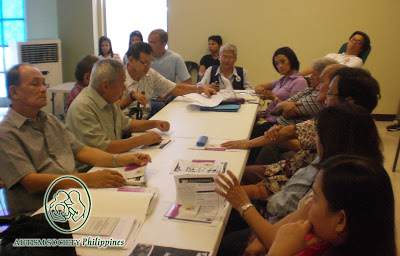
ASP and other national federations like the Katipunan ng May Kapansanan ng Pilipinas (KAMPI), plus 22 Regional Representatives from the different PWD groups, attended the meeting headed by Sectoral Representative, Atty. Albert Yruma.

KAMPI Group during the meeting

Lead government agencies, National Council on Disability Affairs (NCDA), represented by Ms. Marlou Evangelista and Department of Health (DOH), represented by Dr. Franklin Diza, both presented their agencies’ program for 2010.

The group’s thrust, mandate, duties and responsibilities of the council members, was oriented by Mr. Rene Vidallo, NAPC Focal Person on Disability.

For it’s first quarter meeting, each council member reported the programs and accomplishments of their respective organizations. The council also discussed and finalized the agenda of the PWD Sector for the coming three years; which focuses on:

H – Health

E – Education

A – Advocacy

L – Livelihood

S – Social Protection

The National Anti Poverty Commission (NAPC) was created thru the Republic Act 8425, the Social Reform and Poverty Alleviation Act of 1998, better known as the NAPC Law.

The Sectoral Council (SC) is the highest consultative, deliberative and policy review and formulation body of each of the 14 basic sector on anti poverty and right based issues for the respective sector.

The SC is the Basic Sector Wing of NAPC tasked to also engage with any government agency to promote and advocate for the welfare of the PWD sector.

-------------------------

ASP continues to work towards the participation in policy making and advocacy programs that advance the welfare and rights of PWA. Be an Angel for Autism. Donate to expand ASP programs and services. The time is now. Log on to ASP Community Website. Call us at 7-903-5496 or write to autismphils@gmail.com .

ASP Trustee Nominated Into International Theater Organization

ASP Trustee Cristina Estampador-Munarriz has been nominated to be part of advisory board of International Association of Theater for Autism.

The IATA is an international network of parents and professionals who have interests in using applied theater techniques as a teaching modality for autism.

Cristina is a dancer at heart and founded the UP Indayog Dance Troupe while studying Organizational Communication in UP Manila. With her friends in theater, she recently organized heART4humanity, which helps promote the applied arts as a complement to special needs interventions.

“Theater is a great way to teach children, neuro-typical or otherwise. It's always fun and it makes them feel comfortable and less self-conscious about themselves. Using the techniques of theater becomes a veritable teaching platform for social and communication skills to children and adults with autism,” said Cristina.

Cristina’s is mom to Henry, 11 and Derek, 9, both diagnosed with Autism Spectrum Disorder. She believes that any teaching modality that makes her children feel more comfortable with who they are, while embracing and respecting their individuality is worth pursuing. She is currently working on bringing Applied Theater Workshops across the country.

=========

ASP believes that children with autism will thrive given the right environment and opportunities to develop their skills and talents. We continue to work hard for the future of children with autism and their families. Be an Angel for Autism, the time is now. Write us at autismphils@gmail.com or call us at 7-903-5496 for more details.

26 May 2010

Let’s now listen to the neglected family member

By: Dang U. Koe, ASP Chair Emeritus

In her broad experience as special education teacher and former school director of Center for Autism and Related Disorders (CARD), Rosalyn Marie G. Sorongon strongly recognizes the vital role of family involvement in the education and development of persons with autism (PWA).

A lot has been said about autism and its effects on the parents of PWA. “(But) a family is also composed of other children, the siblings,“ emphasized Teacher My (as Sorongon is more popularly known).

In completing her masteral thesis in Special Education at the University of the Philippines (Diliman), Teacher My interviewed siblings of PWA to find out the possible effects of autism on these siblings; their experiences and how they cope as siblings of PWAs and their concerns in relation to their brothers or sisters with autism.

Teacher My advises: “Paying attention and listening to the siblings reinforce the message that they are seen as equally important as their brothers or sisters with autism.”

As trainer of Autism Society Philippines, Teacher My continues to listen to the siblings of PWA by conducting siblings workshops in ASP’s different chapters.

Here Teacher My gives a glimpse on the various experiences of these siblings and their coping mechanisms. The siblings’ responses were grouped according to age groups. For confidentiality, specific names are not given.

Sibling of Children with Autism

• AGES 8 - 12 YEARS OLD

1. When a child with autism (CWA) breaks their siblings’ things or disrupts their study/quiet time, most siblings get irritated or angry. They cope by shouting or crying out of frustration but without telling the adults; others spank or scold the CWA.

2. When parents give more time and attention to CWA, most siblings get jealous. They cope with this either by keeping quiet, sulking inside their rooms, “nagdadabog,” wishing the CWA will disappear, or questioning their parents on definition of “special”.

3. When the CWA hurts oneself, sibling or other family members, siblings either get scared or sad. Others run away for their safety, seek adults’ help or refuse to interact with the CWA. Some apply learned intervention, like massaging CWA with lotion for calming.

4. When CWA can’t understand what siblings want or say, or when the CWA prefers to do things alone, the 8-12 year-old siblings get confused, frustrated, helpless, bored or feel rejected. Others cope by asking help from adults what to do, while others just prefer to interact with other typical children.

5. When CWA disrupts family time due to challenging behaviors, the young siblings are either concerned, irritated or embarrassed in public. Most of them leave addressing the challenging behaviors to the adults.

• AGES 13 - 19 YEARS OLD

1. Most of the adolescent siblings feel deprived of time for oneself when they are asked to care for, teach or join activity of CWA. Some of them are “nagdadabog” or get upset but still follow parents. Others admitted hurting their CWA, while others pass their responsibility to other siblings.

2. When these siblings are disrupted during study/quiet time or their things are destroyed by their CWA, they also get irritated or distracted. Most of them cope by just prohibiting the CWA to enter their rooms or touch their things.

3. Just like the younger siblings, the adolescents get frustrated with the CWA’s communication difficulty and would just prefer to be with peers.

4. Their CWAs’ challenging behaviors irritate or make the teenaged siblings concerned. Some of them do behavior management strategies, others just give in to the CWA’s demand, while others threaten the CWA.

• AGES 20 YEARS OLD – ABOVE

1. The adult siblings are concerned about lackthe CWA being independent and issues of survival and sexuality. Some of them constantly worry and volunteer to teach the skills needed by their special siblings.

2. When family relationships are affected (like parents separating) because of autism in the family, the siblings are of course hurt; but most of them keep quiet or try to accept the situation.

3. Adult siblings become protective when their CWAs are subjected to public ridicule. Sometimes some of them get into fights with rude people.

4. For communication difficulties of their CWA, some siblings feel helpless, while others try other strategies. Others become more understanding of the CWA.

5. These adults fear or are scared they might be carrying autism genes. But they could only worry, not knowing what to do.

6. Some of these siblings are pressured when they feel obligated to carry the responsibility over the CWA when their parents are old or gone already. Some of them cope by opening up their feelings to their parents; others are pressured to look for high-paying jobs.

THINK OUT OF THE BOX

Even though there may be patterns in how they respond, react and cope in a given situation, siblings are still unique individuals belonging to a family that is also composed of unique personalities.

Each sibling of a person with autism has a story to share given that his/her family has its’ own dynamics, living condition, traditions, attitudes and priorities intertwined with the sibling’s own set of value beliefs, opinions, feelings and situation.

They experience what other siblings of families who do not have members with autism go through. They crave for parental attention and time; they have feelings of being responsible and showing concern to siblings in need, of irritation and anger, or issues on sibling rivalry. Their situation only becomes highly emphasized because of autism.

To think out of the box is the challenge posted not only to the siblings but as well as to the parents, professionals and other people who manage to give care and attention to persons with autism.

• PARENTS, IT’S TIME!

For the parents, you may not be used to seriously discussing autism within the family, its challenges and strategies in dealing and/or coping with this condition. Then let’s think out of the box. Probably it’s time to sit down and talk about autism with your family.

You think that you do not want to disturb your other children by discussing the future of their sibling with autism. Think out of the box. The other children might be dying to know your plans and they want to be part of the process of planning for the future of their brother or sister with autism.

On the extreme side, you often nag your other children to care for their brother or sister with autism. Think out of the box. Your other children need to have their own lives too.

• SIBLINGS, EXPRESS YOURSELVES!

For the siblings, you consider it normal not to express to your parents your feelings of irritation, anger, frustration, fear, anxiety – which are all normal feelings – for FEAR you might hurt their feelings. Think out of the box. You tell them exactly how you feel for a good release and they might be able to even help you given the years they have been dealing with the roller coaster of emotions brought about by autism.

You want other people to hear and listen to your needs or concerns. Think out of the box. Speak up just like the few siblings

who have been very courageous in sharing their life stories through video interviews and publishing their written works in leading newspapers and ASP’s newsletters. Probably we, professionals, have a gamut of ideas on how to extend help to the siblings of persons with autism; yet it seems like some of our efforts are not enough. Think out of the box! Probably we need to ask them for suggestions. They might even have better ideas than us. Better yet we need to know first if they truly need our help and if ever, in what areas.

So when we go home and see our other children or our parents or when we go to work and see the siblings of our students with autism, let us THINK OUT OF THE BOX and hopefully next time, the siblings will get to share another side of their story.

ASP conducts back-to-back seminars on May 29: “Inclusion of Children with Autism in the Regular Classroom” with Dr Mercedes Adorio from 9am to 12noon; and “Friends, Puppets, Shades and Games (Fostering Social Inclusion and Mutual Friendship between Children with ASP and their Peers, Siblings, and Classmates)” with Occupational Therapist Anthony Grecia.

Venue is Quality Life Discovery, #70 20th Avenue, Murphy, Quezon City. For details, visit www.autismsocietyphilippines.org or email autismphils@gmail.com.

Source: Manila Bulletin, May 23, 2010

How to apply for the PWD ID in Quezon City?

If you have a child or loved one with autism and a resident of Quezon City, this information might be useful to you.

1. Bring the following items:

a. 2pcs. 1x1 Colored photo of the PWD

b. Proof of diagnosis or disability by a certified/licensed medical professional

ex. Developmental Pediatrician or Neurologist

2. The following items are not necessary for the application, but may help assist your loved one to quicken the application:

a. NCWPD Transportation Discount ID

b. Autism Society Philippines updated family membership ID.
(Call 7-903-5496 for more information)

3. Get the PWD ID Application form from the Social Service Development Department office of Quezon City (see contact details below).

4. Fill out the form and write in all caps AUTISM as disability because it is not specified in the form.

5. There is NO FEE/ NO CHARGE for the application form. The ID will be processed in 2 week’s time (each ID is individually signed by the mayor).

6. The PWD ID will be released together with:

a) Medicines Purchase Slip Booklet

b) Grocery Purchase Slip Booklet

What privileges does the PERSON with AUTISM have?

1. Medical Privileges

Refer to DOH Circular 2009#0011 Click here

2. Basic and Prime Commodities

Refer to Dept of Trade and Industry and Dept. of Agriculture Administrative

Order 2008#02 Click here

3. Get a copy of the Magna Carta for Disabled Persons to know more

RA 9442 Click here

IRR of RA 9442 Click here

Other TIPS:

1. Claim holders should familiarize themselves with the law.

2. Know your child’s rights. Advocate for your child.

3. Have the copies handy when you go out. (Example: when buying medicines or groceries.)

WHAT TO DO IF YOU encounter any resistance or refusal to acknowledge the PWD ID?

For more information visit or call the following:

Quezon City Social Services Development Department

924-1412; 926-9344; 926-1824; 927-1588; 924-1440 (telefax)

National Council on Disability Affairs

Telephone numbers (632) 952-2809, (632) 951-5013, (632) 951-5925

NCDA email address: council@ncda.gov.ph

NCDA website: http://www.ncda.gov.ph

Autism Society Philippines

7-903-5496

Quezon City Autism Angels now Congressmen-Elect

By: Tiffany Tan, ASP Board Secretary

Quezon City Autism Angels, Mayor Feliciano "Sonny" Belmonte Jr. and Councilor Jorge “Bolet” Banal Jr. were declared winners in the congressional race, among two others, after the City’s Board of Canvassers finally released the 2010 poll results.

Belmonte, who dominated the race, served as congressman of District 4 for three consecutive terms (9 years). He also served as House Speaker from January to June 2001. He got the unanimous endorsement from 30 his party members during a party caucus. His party members are campaigning for his House Speakership in the 15th Congress.

Ordinances Benefiting CWDs

Quezon City is the largest of Metro Manila's cities, with a 2.68 million population. During his term as Mayor, Belmonte signed two significant City Ordinances:

1. Ordinance#1801 or the 20% Special Children Discount Ordinance
Click here to read more

2. Ordinance#1915 or the Sustainable Program for Special Children Ordinance
Click here to read more

Annual Camp for CWDs

One of the proponents of City Ordinance 1915 is Bolet Banal, councilor from QC 3rd district. He also ran and won the congressional race this May.

For the past 17 the QC government also holds an annual day camp for children with special needs called “Camp Pag-Ibig.’’ The camp provides participant-beneficiaries with opportunities for socialization and education activities that aim for overall integration and family participation. Congressman-elect Banal has been unwavering in his support for this worthy program by serving as Camp Director for the past 2 years.

Congressmen-elect: (in yellow polo shirt) Sonny Belmonte
and (at the back-left) Bolet Banal during the Camp Pag-ibig Activity

=============

ASP carries the hope of providing more appropriate and meaningful benefits for children with autism and their families. Write to your QC Congressman to enact more laws for people with autism. For more information call 7-903-5496 or email us at autismphils@gmail.com.

Quezon City Ordinance 1801

By: Tiffany Tan, ASP Board Secretary

QC Ordinance No. 1801, also known as the 20% Special Children Discount Ordinance gives special children a 20% discount on their purchase for goods, medicines and services.

It took extensive research, enlisting of the assistance of schools for special children and conducting of interviews with their parents, specially the mothers before coming up with the draft of the proposed ordinance. The ordinance was approved last October 15, 2007.

“The passage of this ordinance is only the first step in the City Government’s determined efforts to address the special needs and concerns of these special children. A more comprehensive and continuing program is being drawn up to provide more appropriate and meaningful benefits for these special groups of young people,” ,” said Congressman-elect Sonny Belmonte.

This QC ordinance rectifies the RA9442, Magna Carta for Persons with Disabilities. PWD residents of QC can now avail of the PWD IDs together with their Medicine Purchase Slip Booklet and Grocery Purchase Slip Booket.

“For so long, I have contemplated a legislative act that would cater to the needs of special children, not only to alleviate their peculiar predicament but also to assuage the plight of the parents,” according to the ordinance’s principal author, QC Councilor Victor “Jun” Ferrer, Jr. (District 1).

Click here to know more on how to apply for PWD ID in Quezon City.

===========

ASP continues to work hard to keep members informed on PWD rights and privileges. Are you an Autism Angel? Write your congressmen to enact more laws for people with autism. For more information call 7-903-5496 or email us at autismphils@gmail.com.

Quezon City Ordinance No. 1915

By: Tiffany Tan, ASP Board Secretary

Quezon City Ordinance No. 1915 is also known as the Ordinance Establishing a Sustainable Program for Children with Special Needs in Quezon City, for the Purpose of Appropriating the Necessary Funds Therefore.

“This is a breakthrough ordinance. This is the first time that a measure of this importance has been approved in the country,’’ said Congressman-elect Sonny Belmonte (QC Fourth District).

Members of the ASP National, ASP Diliman and ASP Lagro Chapter, officers, members and children with autism witnessed the signing of the ordinance last April 2, 2009.

ASP Board of Trustees, ASP Diliman and Lagro Chapter representative with CWA witness
the signing of Ordinance 1915 with (seated from right) Congressman-elect Jorge “Bolet” Banal,
re-elected Councilor Jesus “Bong” Suntay & Congressman-elect Sonny Belmonte

Congressman-elect Jorge “Bolet” Banal of District 3 and co-author, re-elected Councilor Jesus “Bong” Suntay of District 4 specifically chose World Autism Awareness day for the ordinance to be signed.

Batas Pambansa 232 or the Special Education Act of 1972 recognizes the State’s responsibility to provide special education services within the formal school system and emphasizes the right of every individual to relevant quality education regardless of one’s physical or mental conditions.

The ordinance will provide for the necessary facilities for the special children and hiring of additional technically skilled teachers and trained workers who can comprehensively effectuate the subject of this measure. (Currently there are about 120 SPED teachers employed by the QC government.)

Other provisions include free educational intervention with rehabilitation and counseling services, establishment of special coordinating day care centers for all special children in the four districts, mainstreaming pre-school CWD for integration into regular classes.

Family members will be motivated to actively participate in the rehab activities of their children or siblings by providing them opportunities to enhance their knowledge and skills in assisting PWDs. This will be made possible through close collaboration with SPED workers and caregivers.

Public awareness through advocacy and networking; support in mainstreaming into the community life activities will also be supervised by the administrative agency who shall oversee the proper implementation of the provisions of this ordinance.

=========

ASP continues to work hard to keep members informed on PWD rights and privileges. Are you an Autism Angel? Write your congressmen to enact more laws for people with autism. For more information call 7-903-5496 or email us at autismphils@gmail.com.

24 May 2010

ASP Davao Chapter, June 5 Seminar on PWA Adult Life

Adult Life and Sustainability and Independence

*please click picture for larger view

Niko’s Musical Journey, “No fear, Shakespeare!”

By: Gina Bermudo, ASP Trustee

Nicholas is the only special child among the thirty-three (33) talented young adults aged 14 to 17 in the summer acting workshop of Trumpets Playshop. In the beginning, I feared Niko might not be able to cope with the rigorous demands of a theater workshop.

Portraying emotions is not one of the strengths of children in the autism and acting would require a lot of energy and emotions to give justice to the character being portrayed. I had my doubts, but went ahead and enrolled Niko. I felt this will be a very important milestone in my eldest son’s journey towards mainstream Musical Theater.

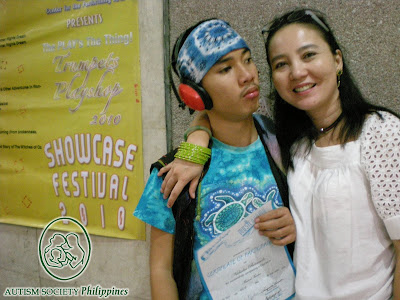
Gina and Niko Trumpets

Culminating day came. Niko was in costume-a tie-dyed shirt with a black hooded vest, a 70’s bandana tied around his forehead, jeans and brightly colored sneakers. My chest pounded, while waiting for the show to start. My mind was filled with the worst scenario - Will Niko be distracted? Will Niko lose focus? I psyched myself up and prayed fervently.

Niko’s performance was beyond my expectations He navigated the stage with ease. He was confident and beamed with pride. He danced with gusto, feeling like a seasoned artist! When he bowed after the show, a very loud applause came from the audience. I could not control my emotions any longer and shed some tears of joy.

I felt so proud of Niko. He handled himself well during the entire acting workshop. He had his shortcomings, acting wise, but he transcended his limitations and performed to the best of his ability. And, he surely won the hearts of his classmates and his teachers. That day, he was not the main character in the show but he will forever be a superstar in my heart.

Niko is a perennial hyperactive young adult with autism, and has a lot of energy to spare. He joined other youths last May 20 “No fear Shakespeare!” (A Musical) at the Auditorium A, Greenhills Christian Fellowship Building, Ortigas Center.

============

ASP believes that children and young adults with autism will thrive, given the right environment and opportunities. Be an Angel for Autism. Buy your copy of “Mga Awiting Alay sa Autismo” by calling 7-903-5496. Part of the proceeds of the CD will help ASP programs and services. For more information email us at autismphils@gmail.com or visit our community website.

21 May 2010

The So Called “Normal” World

By: Amaris Grace M. Cabason ASP Marikina Valley Chapter

"Why would you feel sorry for someone who gets to opt out of the inane courteous formalities which are utterly meaningless, insincere and therefore degrading? This kid doesn't have to pretend to be interested in your back pain or your excretions or your grandma's itchy place. Can you imagine how liberating it would be to live a life free of all the mind-numbing social niceties? I don't pity this kid, I envy him," said Dr. Gregory House of his autistic patient -- From the TV series “House”

This quote has much meaning in my life because, one, I am tired of mind-numbing social realities, and two, my youngest brother, suffers from borderline autism. Unless you know the symptoms of autism, Vinz would pass off as a normal kid.

Sisters Amaris and Issa with Brother Vinz

He used to have trouble keeping eye contact. He has problems keeping still. He runs around and dances without music. He talks to strangers and sometimes, to no one in particular, but he goes on as if he is actually conversing with someone. He gets frustrated easily. He asks questions, out of the blue and answers them by himself -which shows, he already knew the answers to those questions anyway! He has fixations like green socks, the number 9, and Mr. Bean.

Social norms, status quo and proper behavior are things he has difficulty understanding. Vinz has trouble knowing right from wrong. There is no black or white to him. The only time he knows he did something bad, is when he is scolded or when get mad.

One problem is particularly difficult. This has happened once too many times before, at different malls, shops, and grocery stores. Once he sees something he wants, he has to get it NOW or else he would throw a fit.

It would be embarrassing, not to mention utterly frustrating, because calm explanations to Vinz would not work. He would scream (shriek would be a more appropriate word) with every ounce of strength each of his vocal cords can muster, scratch and punch the unfortunate person who tries to hold and restrain him. And more often than not, we have to physically carry him away from the object of interest, hurry out the mall or cut short our trips.

Vinz’s autism diagnosis was confirmed at three years old. To help him with communication and behavioral modification and coping in school, his Developmental Pediatrician recommended Speech and Occupational Therapy. Since both my parents have to work full-time everyday, I was tasked to accompany him to his M-W-F therapy.

Living 24/7 with an autistic brother is quite an experience. But seeing him in a school where many like him ran around comfortably and where he belonged is a completely different encounter.

These kids, like Vinz, do not fit-in in our so-called “normal world”. What good is a normal world of niceties and notoriety? A normal world of extremes we all have to deal with, all at the same time? What do these kids miss out on anyway? Come to think of it, whose loss is it really? The ability to lie our way through something? To use deceit just to be on top? To worry about worldly things and do anything just to achieve them?

I thank God for how Vinz’s condition reminds me of innocence, and how easily we lose it or taint it as we grow older. It is not just the state of blankness or openness a child has that needs to be filled; but the bliss of constant amazement and curiosity.

Never holding grudges and easily saying “to forgive is to forget”. Asking questions and depending on Mom or Dad for answers instead of shutting them out from our life as soon as we become teenagers.

It’s that steady smile on his face that makes me envy him, devoid of shallow worries about what to wear or where to go; or how to make someone like us, or worse, how to be like someone else for them to like us.

It’s all those things -- or rather, the absence of it -- beautifully woven and protected by innocence. That, sometimes, makes me think, that perhaps, we are the ones who missed out on what it means to be part of “their world”… and that they are the lucky ones.

*Reprinted from ACAP News 2009

=============

Amaris Grace M. Cabason is an incoming 2nd year student at the San Beda College of Law. She is the daughter of Alex and Marivi Cabason, President and First Lady of ASP Marikina Chapter. Be an Angel for Autism. Donate now and help ASP Chapters with their programs and services. Log on to ASP Community Website. Call us at 7-903-5496 or write to alexcabason@yahoo.com .

20 May 2010

Senators Filed Autism Bills Declared Winners by Comelec

By: Tiffany Tan, ASP Board Secretary

Senators who filed autism bills in the 14th Congress have been proclaimed winners by Comelec on May 15, 2010.

Among the top 5 senators include Senator Jose “Jinggoy” Estrada and Senator Miriam Defensor-Santiago; who ranked 2nd and 3rd, respectively.

Last November 7, 2009, Senator Estrada has called on fellow legislators to approve his Senate Bill 618 or the Center for Autism Act.

Dr. Alexis Reyes, President of the Philippine Society for Developmental and Behavioral Pediatrics, that there may be about 500,000 Filipinos with autism today, but only about two percent of them are given appropriate care.

Initial diagnosis for autism costs about P7,000, with total cost of medical and educational needs amounting to more than P110,000 for the first year alone.


Based on Estrada’s bill, the Center for Autism shall formulate and implement an integrated and comprehensive master plan on autism, create a diagnostic, therapeutic and rehabilitation clinic; provide vocational training programs for autistic adults; give free diagnosis and rehabilitation services to indigent autistics; train teachers, therapists, medical and health workers on the nature and management of autism; and, increase public awareness and concern on autism by spearheading advocacy programs.


Misuse Autism, Appease Autism

Senator Santiago is not immune from autism controversy. In the past, she has misused “autistic” during the hearing of Euro Generals and during the proliferation of infomercials of fellow senators/other candidates before the elections. After reminding the provisions on RA9442, her PR and Legal Advisers have sent letters of apologies to ASP office.

Senator Santiago filled two bills for autism. Senate Bill 2940 or The Autism and Infant Autism and Infant and Toddler Immune System Disorders Act and Senate Bill 1946 or The Autism Prevention, Early Detection, Diagnosis and Treatment Act. Both bills are deferred to the Committee of Health and Demography awaiting second readings.

We are hoping the good senator will push to have these bills signed to prove her sincerity.

(Source: Philippine Senate)

=============

ASP is working hard towards the signing of these bills. Call and write to your senators for the quick passage of these bills. We will keep you posted for more news and updates. Be an Angel for Autism. The time is now! Donate to ASP by logging on to Autismo sa Pinas or write to autismphils@gmail.com. For more information call us at 7-903-5496.

To know about other autism bills filed, click here.

ASP Websites Credited to Volunteer Autism Angels

By: Cris Estampador, ASP Trustee

Autism Society Philippines wishes to thank volunteers stepped forward and generously gave their time and expertise to help us.

The ASP Board of Trustees is happy with the outcome of the new website, www.autismsocietyphilippines.org. “A lot of disability advocacy groups and non-profits are floored by the design. They think that we spent a lot on it,” said ASP Executive Director, Ranil Sorongon.

That impression is actually the opposite of the truth. The credit for the design goes to the people of Leo-Burnett that were headed Ben Reyes and Kandice Ting for managing the team that designed it.

The ASP Website by Leo-Burnett

We wanted to veer away from the usual puzzle symbol for autism. Using a puzzle piece to represent autism willimprint into our consciousness; to see and think ‘AUTISM as a PUZZLE’ thus, ‘AUTISM simply IS a PUZZLE’. This association will ultimately serve as an obstacle in itself and makes it harder to find a solution. We wanted something more optimistic and more heart-based.

Leo-Burnett and team made it happen for us. The moment I saw the design, I wanted to hug the team immediately. Photography was done by Certified Autism Angel, John Chua of AdPhoto and the execution of the site was done by Passion Overdrive Digital Services.

ASP wanted to remain financially viable for our constituents and stay relevant to these families. Harnessing the best of Internet Technology answered this challenge to move priority projects.

ASP has also become recognized internationally by the World Autism Organization, Autism Society of America, Autism Hearts Foundation, ACES Angels to name a few. Through the internet, ASP is able engage the Philippine Autism Community, reaching out and communicating to members or users in far flung provincial areas, who needed help.

ASP is also thankful for other volunteers who have given their expertise in helping solidify its internet presence. Web design for Autism Beyong Borders Conference site was provided by DeLa Salle- College of Saint Benilde students, Jen Chua and Diane Pua. These talented girls also took care of the ingenious design collaterals for successful conference.

The ABB Website designed by Jenny Chan and Dianne Pua

The girls also get the credit for the background for Autismo sa Pinas, ASP’s community site. ASP’s internet presence is not only about setting up their information on websites or social networking sites. At the back-end of all this technology, information databases also have to be protected.

The Autismo sa Pinas Community Website

Internet professionals, such as Paul de Paula of Optimum Sources, Inc., have volunteered on more than one occasion to help restore and secure ASP’s website.

There is still a lot of improvement needed and ASP constituents have been very vocal in telling ASP what they need from its websites and their comments are very much appreciated by the ASP Executive Committee.

This wouldn’t be possible if these volunteers did not step forward and generously gave their time and expertise to help us. We are always, always thankful for these wonderfully talented and giving angel volunteers.

Cristina Estampador, is ASP Trustee and Tech Visionary. Her background in IT & Finance channels ASP to explore new avenues in management and economics. Her cutting-edge ideas take ASP to a whole new level in marketing and internet communications. She has two boys on the spectrum, Henry, 11 and Derek, 9.

UP Students produce DAISY Digital Talking Books for CWA

Students from University of the Philippines produce DAISY Digital Talking Books to address specific difficulties in comprehension, extinguishing disruptive behaviour and improving social skills of children with autism. This undertaking is in line with their thesis in the Master’s Program of Special Education.

DAISY or Digital Accessible Information System was introduced to ASP in February 2008. DAISY is believed to be ideal format for reference materials and learning resources to persons with disabilities, including autism.

Adavieve Mella, one of the students, started producing her first batch of DTB using the Dolphin Publisher. The Dolphin Publisher makes the creation of DAISY digital talking book easier and faster; and allows the navigation structure and the layout of the books to be tailored exactly to suit the requirements of user person with disability.

According to Mella, producing a DTB was not an easy task. It required meticulous efforts to understand the technicalities in using the software. It was unavoidable to experience various problems in producing a DTB. Among the problems that were encountered was validating a DTB book. A DTB would not be valid unless it meets the required settings.

Such unique problem has not been previously encountered by DAISY DTB trainers like Ms. Bing David; therefore, technical assistance was forwarded to Ms. Mayu Hamada, the DAISY DTB trainer from Japan. Through their positive and supportive responses; Mella was able to produce the first three DTB needed for her study. She continues to visit ASP on a scheduled basis to produce her DTBs.

ASP is licensed by the DAISY Consortium, the company which develops, maintains and promotes international DAISY (Digital Accessible Information System) Standards. With written permission to use the Dolphin Publisher, students like Mella can continue to pursue knowledge and bear positive results for care and assistance of children with autism.

=========

ASP continues to explore different avenues to educate students and professionals helping children with autism. Be an Angel for Autism. Donate now to support ASP programs and services. For more information on DAISY, email us at autismphils@gmail.com or call us at 7-903-5496.

19 May 2010

May 29 Back to Back Seminar

Inclusion of Children with Autism in the Regular Classroom
29 May 2010, 9:00 am - 12:00 nn
Quality Life Discoveries, #70 20th Avenue, Murphy, Quezon City

This seminar will discuss how schools can effectively adjust their curricular framework to accept students with disabilities, including children with autism. The seminar will also present ways of accessing the regular education curriculum and how students, with and without disabilities are evaluated. Participants will learn different approaches on how to make ALL students function in an inclusive classroom environment.

Dr. Mercedes Adorio obtained her Ph.D. in Educational Psychology & Educational Sociology in UP and has served as College Secretary (1992-1995) and as Faculty-in-Charge of the Special Education area of the Division of Curriculum and Instruction. She is often invited as resource person in national and regional school divisions and has presented papers in international conferences. She is the author of Special Education in the Philippines: Trends and Issues. Dr. Adorio was a former professor of Special Education of UP, Diliman. She is currently teaching SPED at the Philippine Women’s University.

Friends, Puppets, Shades and Games
Fostering Social Inclusion and Mutual Friendship Between Children
with ASD & their Peers, Siblings and Classmates
29 May 2010, 1:30 pm - 4:30 pm
Quality Life Discoveries, #70 20th Avenue, Murphy, Quezon City

This seminar will discuss and help participants understand the importance of peer play and friendships. It will also discuss the key features of the Friend to Friend model. Participants will also get to experience Autism Demystification (developed by F2F Social Learning Society and Dr. McCracken) through a puppet show and a simulation game). It will also discuss other activities that can be done after demystification programs are done in school or community.

Mr. Anthony S. Grecia obtained his Bachelors Degree in Occupational Therapy at UP- Manila, College of Allied Medical Professions. He finished his MA in Psychology with concentration in Clinical Counseling at the Ateneo de Manila University (ADMU). He is currently pursuing his doctorate degree in Clinical Psychology at ADMU. He is the present Program Director of the three branches of Center for Goals Inc.(Alabang, Caloocan & Bonifacio Global City)He is the former Chairman,Committee on Membership and Nominations of Occupational Therapy Association of the Philippines (OTAP Inc.). He is also a founding member of Therapy Centers’ Movement (TCM).

Pre-Registration (until May 26, 2010)
Single Seminar (Member) - P 400.00
Single Seminar (Non-member) - P 500.00
Double Seminar (Member) - P 700.00
Double Seminar (Non-member) - P 800.00

On-site Registration
Single Seminar (Member) - P 500.00
Single Seminar (Non-member)- P 600.00
Double Seminar (Member) - P 800.00
Double Seminar (Non-member) - P 1,000.00

The seminar fee is inclusive of certificate, handouts and snacks. Pre-registered participants may pay to Autism Society Philippines, Banco de Oro, Savings Account # 3980002955. Please fax the deposit slip with the name/s of participant/s to ASP office and bring it on the day of the seminar. On-site registrants will be accepted depending on the availability of slots. There will only be 70 slots available. No refund will be given to participants who did not show up on the date of the seminar. For more details, please call ASP at 7-903-5496

The ASP Seminar Series serves as a platform to educate Filipino parents and professionals on the various interventions, modalities and theories surrounding Autism Spectrum Disorder. Their application and implementation are left at your discretion. The views and personal experiences of the speakers are of their own and don’t necessarily reflect that of the views of the organization.

15 May 2010

ASP Seen as Model Parent Organization

Everybody will agree that parents play a vital role in the lives and successes of their children with disabilities (CWD). Since these children can’t represent themselves, parents represent their children in meetings, conferences, foras and organizations; parents assume the role of advocates.

The recent passage of the UN Convention on the Rights of PWD (UNCRPD) affirmed the crucial roles of parents in all facets of their child’s development and to represent their children in any organization or body. The convention also challenges the parents to be active and vigilant in claiming their and their children’s rights as provided in the UNCRPD.

Educating Parent Advocates

In response, to this situation and the challenges of the UNCRPD, the Katipunaan ng May Kapansanan sa Pilipinas (KAMPI), through their Breaking Barriers for Children and Youth (BBCY) Project, organizes parents in their project areas around the country.

ASP was visited by 10 parent leaders from BBCY last February 22. With them is Dr. Adora del Rosario, ASP member and former president of The Stimulation and Therapeutic Activity Center (STAC), Quezon City.

ASP Executive Director Ranil Sorongon gave a short orientation to the group about ASP programs and services. He also gave practical tips on how to organize and maintain an organization.

The group was amazed on how from a team of 11 mothers, ASP has grown to 42 Chapters around the country. Sorongon was then invited to their forthcoming assembly and planning.

On April 20, Sorongon joined the more than 30 parents at Cuidad Christia in San Mateo Rizal and helped the group in coming up with their activity plan. He also gave inputs on advocacy, in dealing with PWD organizations, government agencies as well as the management of their organization and its sustainability.


Acknowledgments: Ms. Hazel Borja, Program Manager and Ms. Visitacion Apostol, Project Director.

========

ASP believes in the power of parent support and advocates. We continue working hard for the future of our children. Be an Angel for Autism. The time is now! Donate to ASP by logging on to http://www.autismsocietyphilippines.org/ or write to autismphils@gmail.com. For more information call us at 7-903-5496

ASP Naga City Chapter May 28-29 Seminar Series

The newly revitalized ASP Naga City Chapter, headed by chapter president, Ms. Niña Sibulo, will have a two day Autism Seminar Series on May 28 and 29 at St. Joseph School, Panganiban, Naga City. The induction of the newly elected officers and an orientation of the plans and programs of the chapter will precede the seminars.

Topics and speakers as follows:

I. Science of Autism and Other Related Dis orders by Dr. Teresita de Castro, DevPed

II. Program Making /Placement and Laws & Rights of Special Children

III. Intervention / Support Provider; Occupational Therapy in Pediatrics; Sensory Processing Disorder; Behavioral Modification Techniques by Ms. Mildred Serra, OTRP

IV. Utilizing ABA Principles in classroom instructions by Ms. Lilia Monserate,MA SPED

V. Language of Autism by Ms. Danielle Escano, SLP

VI. Dietary Management for Mentally Compromised Children by Ms. Salve Gonzalez, RN-D

Testimonies from selected parents will commence the seminar series. The Seminar Series is in cooperation with St. Joseph School and Lance Yuri Kids Spot Center. For more information on the seminars contact Teacher Myla at 0920-914-0071.

The ASP Seminar Series serves as a platform to educate Filipino parents and professionals on the various interventions, modalities and theories surrounding Autism Spectrum Disorder. Their application and implementation are left at your discretion. The views and personal experiences of the speakers are of their own and don’t necessarily reflect that of the views of the organization.

14 May 2010

What are the Medical & Dental Privileges of PWDs?


RA 9442 or the Magna Carta for Persons with Disabilities accords privileges and incentives for PWDs.

***At least twenty percent (20%) discount for the purchase of medicines in all drugstores for the exclusive use or enjoyment of persons with disability;

At least twenty percent (20%) discount on medical and dental services including diagnostic and laboratory fees such as, but not limited to, x-rays, computerized tomography scans and blood tests, in all government facilities, subject to guidelines to be issued by the Department of Health (DOH), in coordination with the Philippine Health Insurance Corporation (PHILHEALTH);

***At least twenty percent (20%) discount on medical and dental services including diagnostic and laboratory fees, and professional fees of attending doctors in all private hospitals and medical facilities, in accordance with the rules and regulations to be issued by the DOH, in coordination with the PHILHEALTH;

What are the PWD Medical and Dental Privileges in Government Facilities?

The person with disability shall be provided at least twenty percent (20%) discounts on medical and dental services including diagnostic and laboratory fees such as, but not limited to, x-rays, computerized tomography scans and blood tests in all government facilities, subject to guidelines to be issued by DOH in coordination with the Philippine Health Insurance Corporation (PHILHEALTH).

What are the PWD Medical and Dental Privileges in Private Facilities?

The person with disability shall be provided at least twenty percent (20%) discounts on medical and dental services including diagnostic and laboratory fees such as, but not limited to, x-rays, computerized tomography scans and blood tests including professional fees of attending doctors in all private hospitals and medical facilities subject to guidelines to be issued by DOH in coordination with the Philippine Health Insurance Corporation (PHILHEALTH).

Definition of Terms:

Medicines – refers to both prescription and non-prescription medicines and articles approved by Bureau of Food and Drugs (BFAD), Department of Health (DOH), which are intended for use in the diagnosis, cure, mitigation, treatment or prevention of disease in man.

Medical Services – refers to health services as defined by Section 20 of Republic Act 7277, which includes but not limited to prevention of disability through immunization, nutrition, environmental protection and preservation, and genetic counseling, and early detection of disability and timely intervention to arrest disabling condition; and medical treatment and rehabilitation to include mobility assistive devices.

Dental Services – refers to oral examination, cleaning, permanent and temporary filling, extractions and gum treatments, restoration, replacement or repositioning of teeth, or alteration of the alveolar or periodontium process of the maxilla and the mandible that are necessary for the diagnosis and/or treatment of a dental illness or injury.

For more information on the RA9442, click here.

CWAs Shine in Kamp Pagkakaisa 2010

ASP Program Assistants Cathy Genovia and Abby Mendoza volunteer yearly to PVI Kamp Pagkakaisa to mentor other volunteers helping children with autism.

Cathy served as the Kamp Secretary while Abby as the Assistant Kamp Secretary . PVI members also volunteer in ASP activities during ASP Family Day Celebrations and join ASP's Angels Walk.

The yearly camp was dubbed as Kamp Pagkakaisa, which catered to children from Department of Social Welfare and Development or DSWD and children with disabilities. This year’s camp was held at Mexico Central Elementary School, Pampanga headed by Kuya Mark Rosario, Kamp Director. Below are some of the testimonials.

Mr. Fix-it Guy

This year, Muneer, son of ASP Cavite Chapters Governor, Jan Peña, joined the camp. Muneer is joined by his sister Thea, who volunteered to be one of the Junior Counselors.

“Muneer is loved by everyone. Although non-verbal, he showed his enthusiasm. He made sure that everyone’s ID was worn properly, fixing them to the right position, when the ID is worn in reverse. One time when all the delegates were preparing for an evening performance, Muneer suddenly ran to the stage to fix the fallen letters from the backdrop and fixed them one by one. It’s interesting to see him use his fixations to help other volunteer campers,” said Ate Abby Mendoza.

(left photo) Muneer fixing ID lace (right photo from left) Program Coordinator,
Ate Dyuli delos Reyes,Info Officer, Kuya Teng Nacino, Asst Kamp Director,
Kuya Randy Valenciano (seated), Muneer,PVI Founding Member and
President, Tita Derly Salud and Seasoned Volunteer, Ate Lyn Garcia

Kitchen Kiddie Staff

We had a very challenging camper named Brian, also a non-verbal . During the first three nights, he had a hard time sleeping and looked like he is waiting for someone. His teachers and also this year's Information Officer and Asst Kamp Director respectively, Kuya Walter Nacino and Kuya Randy Valenciano, deduced his behavior was due to him being separated from his family for the first time.

“We discovered his interest for cooking after his several attempts to go to the camp’s kitchen. During siesta time, we allowed Brian to join as “kiddie kitchen staff” to help with simple kitchen duties,” narrated Senior Counselor Kuya Jess Benitez.

=================

ASP believes that children with autism will thrive given the right environment and opportunities to develop their skills and talents. We continue to work hard for the future of children with autism and their families. Be an Angel for Autism, the time is now. Donate generously to Autism Society Philippines- Metrobank (Kamias Branch), Account No. 047-3-04751874-2. Write us at autismphils@gmail.com or call us at 7-903-5496 for more details.

PWD Plans for Unified Action against Drug Stores

The sector of Persons with Disabilities (PWD) planned a nationwide action to claim their legal rights. Part of it is filing of a class suit against one of the biggest drug store chains in the country, Mercury Drug Store and the members of the Drug Stores Association of the Philippines (DSAP).

On May 12, 2010 more than 20 PWD leaders representing the different disability groups both from national and provincial organizations convened thru the initiative of Mr. Lauro Purcil Jr., board of governor of the Katipunan ng Maykapansanan sa Pilipinas Inc. (KAMPI-NCR). He also presided the meeting.

Mr. Purcil Jr. and KAMPI-NCR group during the meeting

The planned suit came as a result of the reluctance of Mercury Drug and DSAP to implement the provision of Republic Act 9442, which entitles the PWDs twenty percent (20%) discount for the purchase of medicines in all drugstores. RA 9442 was signed by PGMA since last April 30, 2007.

ASP Executive Director, Ranil Sorongon, together with Ms. Gigi Ruiz, former Executive Director of National Council for Disability Affairs and Carmen Zubiaga, President of WOW-LEAP (Women on Wheelchairs Leap to Social Progress) were tasked to create a program plan pertaining to this endeavor.

A formal complaint will also be submitted to the Food and Drug Administration to issue a “Writ of Mandamus” to compel Mercury Drug and DSAP members to follow the law. The group is looking for lawyers that will serve as legal counsels of the sector.

Acknowledgements to Mrs. Mary Ann Cua of Quality Life Discoveries (QLD) for hosting the meeting and providing snacks. QLD is a Special People's Hub, the country's first integrative rehabilitation center that offers holistic services for the well and differently-abled located in Cubao, Quezon City.

=========

To know more about the medical and dental privileges of persons with disabilities, click here.

ASP Trustee Carmel Almendrala, Ulirang Ina 2010

By: Cathy Genovia, ASP Program Assistant

ASP Trustee Carmel Almendrala receives the Ulirang Ina 2010, Special Awards Category, under Special Citation at Century Park Hotel, Manila.

The annual Ulirang Ina Awards is an initiative of the National Mother's Day and Father's Day Foundation of the Philippines, Inc. which selects outstanding model Filipino Fathers and Mothers.

But Tita Carmel was hesitant to attend the awarding ceremony. Her husband, Tito Fred, was scheduled for a corneal transplant, one day before the event. Tita Carmel decided to cancel and told Tito Fred about her decision.

Being a prayerful wife, she turned to God for help. Her prayers for a successful surgery were answered. Tito Fred, who wanted so much to accompany his wife to the ceremony, was however not given a doctor's clearance.

Tito Fred and Tita Carmel at the Medical City

Happy Mother's Day

On May 9, Tita Carmel was instead accompanied by her son, Michael. The occasion was deemed fitting for it fell on Mother's day. Her unending love, care and support to her children, especially to Mike, is what she believed brought her to this recognition.

(from left-right) PWA Mike, Awards Chairperson Leticia Talag,
ASP Trustee Carmel Almendrala, Secretary Mona Valisno and
Foundation President Wilfredo Tayag

Mike is a loyal employee of Philippine Information Agency (PIA) since 1999. As a contractual employee, he worked his way to become a casual on 2002. In 2005, he passed the accreditation exam through TESDA and was a nominee for Apolinario Mabini Award, the first person with autism to win the eligibility for Civil Service. His permanent civil service position was accorded on November 2009 and assures him security of tenure. Mike is also a special Olympian, gold medalist power lifter.

"Our son Michael's journey is a 'saga' which we in the family share proudly. He was the 'family project', and what we unabashedly consider as our greatest trophy. Although I continue to watch over him, my days are now spent in my other advocacies: for people with disabilities; or the welfare of the elderly in our area; some church work; and generally thankful for Mike and my family who have helped me become what I am". (excerpt from Tita Carmel's essay)

Saludo kami! Congratulations Tita Carmel!

====================

ASP salutes autism mothers who dedicate their lives for a brighter tomorrow. be an Angel for Autism. Do you have story to tell? This is your chance to inspire others dealing with autism. Email us at autismphils@gmail.com or call us at 7-903-5496.

Seminar-Workshop on Autism in Rosales, Pangasinan

ASP Rosales Chapter in partnership with the Stimulation and Therapeutic Center (STAC) of Rosales, Pangasinan is scheduled to have a seminar-workshop on the Management of Children with Autism and Learning Disabilities this coming May 19 and 20 at STAC Building beside the municipal hall of Rosales, Pangasinan.

ASP Trainer, Rosalyn Marie Sorongon, together with her mentor, former UP Diliman Special Education Department Professor Mercedes Adorio will provide the training for public school teachers and the staff of STAC Rosales.

(L-R) Dr. Mercedes Adorio and Teacher My Sorongon in one of their lectures in ASP

The seminar-workshop is sponsored by the Municipality of Rosales headed by Hon. Mayor Ricardo V. Revita. For more information please contact Teacher Fatima Pilotin at 0921-546-0578.

The ASP Seminar Series serves as a platform to educate Filipino parents and professionals on the various interventions, modalities and theories surrounding Autism Spectrum Disorder. Their application and implementation are left at your discretion. The views and personal experiences of the speakers are of their own and don’t necessarily reflect that of the views of the organization.

New Autism Orientation Template for Camp Volunteers

By: Cathy Genovia, ASP Program Assistant

ASP gave a lecture to 60 Manila volunteers and 70 volunteers from Pampanga, La union and Pangasinan. The volunteers are members of Pagkakaisa Volunteers Inc. (PVI).

PVI members are required to attend a Training Series to help them face the challenges of dealing with different kinds of children with special needs (Autism, Downs Syndrome, Cerebral Palsy, Deaf and others with intellectual disabilities). Volunteers serve as counselors during a yearly camp to assist the children with their needs.

Teacher My Sorongon, ASP EDEIP (Early Detection and Early Intervention Program) Trainer, who also frequently lectures on autism, used some data that came from last year’s PVI Kamp.

Patterning after ASP’s Mall Orientation format, a new one was developed to cater to the Camp Volunteer’s specific needs. Thus the development of the new ASP streamlined “Understanding your CWAs (Campers with Autism)”.

Teacher My during her lecture in PVI Training

A special section on “What To Do?” answered some of the apprehensions of the volunteers. One section focused on understanding children with autism. The key is to look for something that will help us connect with them and them, with us. Click here to read our testimonials.

PVI Volunteers were at first intimidated with children with autism, as they are the hardest and most challenging wards to handle, compared to other children with disabilities. But thanks to the unending support of Autism Society Philippines’ Executive Director, Ranil Sorongon and Teacher My, PVI volunteers are now more equipped and more understanding of campers with autism.

A ten day therapeutic summer camp followed after the orientation. It was held last April 8-17, 2010 at Mexico Central Elementary School, Mexico, Pampanga and was headed by Mark Ernest Rosario, Kamp Director of Kamp Pagkakaisa 2010.

=========

ASP works hard to erase misconceptions about autism. To request for a streamlined “Autism Orientation” for your institutions or organizations, email us autismphils@gmail.com or call us at 7-903-5496 for more details.

ASP National Office in Partnership with Chapters Conducted Seminars

By: Ranilo Sorongon, ASP Executive Director

Autism Society Philippines (ASP) and its chapters sticks to its mission of equipping parents, professionals and students by bringing professionals to the provinces, imparting current and time tested practices in the management of autism.

Facilitating Communication at Home and School Seminar was conducted in the Roxas City (March 20) with ASP Roxas City Chapter, (May 7) in Iloilo City with ASP Iloilo City Chapter and (May 8) in Batangas City with ASP Batangas City Chapter. ASP is fortunate to have an ally in Ms. Kate Reyes, speech and language pathologist to travel to the different chapters. Kate is a former lecturer at the UP College of Medical Professions (CAMP), Manila and is currently working with ASP to develop modules to be used as training tools for parents and professionals. There were more than 150 participants in the four seminars.

Sensory Integration Seminar (April 7) with ASP Iloilo City Chapter was facilitated by Ms. Chrissy Coronel-Andigan, a former head of the Occupational Department of UP CAMP, Manila. She recently migrated to Iloilo City and is now connected with the Emmanuel Foundation for Children with Special Needs, Inc. Forty-five attendees joined the seminar at the World Bank Knowledge and Development Center located at Central Philippine University. The Office of Person’s with Disability Affairs (OPDA) thru Ms. Dolly Laudenorio provided food for the participants.

Vocational Training Seminar (May 8) at ASP Batangas City Chapter was conducted by one of ASP’s regular speakers, Ms. Maria Yolanda Michelle Bautista. Teacher Landa is the curriculum coordinator of the Learning Center (TLC), based in Parañaque City. TLC is one of the oldest schools for children with special needs. Her lecture focused on the TLC experiences for pre-vocational and vocational training. Thirty parents, professionals and students attended the seminar at the Teachers’ Conference Center at Batangas City courtesy of the City Government of Batangas.

Proceeds of the seminars helped the chapters fund other activities like photo workshop and exhibit, family day, walk and others.

==========

ASP Chapters need your help and support. Be an Angel for Autism. Donate now to ASP Chapters and help educate more people in the rural areas, where autism is still taboo and misconceptions rampant. Log on to our community website to know more of our programs and services and click here to help. For more information click here or call 7-903-5496 for more details.

HOME for young people with autism

By: Dang Uy Koe, ASP Chair Emeritus

What will happen to our child (with autism) as he grows older? Where will he live? What will he do?”

Of all the practical issues surrounding the growing adult populations with autism, the need for residential options seems most pressing but least addressed, if at all.

In some countries, like USA, community housing options for adults with autism are available for them to live and thrive in the communities they know. Such residential models include group homes, supportive living, supervised living, farmstead programs, community living options, family teaching model, cooperatives, and shared housing.

These community housing options should not just be sustainable, integrated, accessible, and affordable. Most importantly, they should be real homes that are specifically adapted to support the needs of adults with autism. (source: Foundation for Autism Support and Training (FAST), Maryland, USA).

HERE IN THE PHILIPPINES, WE HAVE HOME

Autism Society Philippines recently launched the H.O.M.E. Life Program. HOME stands for Harnessing Options in Managing Everyday Life.

The objectives of the H.O.M.E. Life Program are (1) to assess the residential abilities of youths and adults with autism, as well as other developmental disabilities and (2) to explore possibilities in living/residential arrangements in an enabling community.

The HOME Life Program commenced with several PWA (persons with autism) boarders staying inside a residential home for five days and five nights. The PWAs are assessed based on how they are able to manage a 24-hour schedule on their own, with the least amount of supervision.

From Autism Resource Center (ARC), Laguna, there are six boarders and three each from the following partner schools, Holy Rosary College in Sta. Rosa City, Hope Intervention Center in Calamba City and Kids Spot Intervention Center in San Pablo City.

Angels Talk collated some of the observations of the parents and care-givers who were there to observe the activities. Many reported increase in social skills and compliance with house rules.

• “Although Philip is non-verbal, he learned to socialize with other boarders; followed instructions given to him”, said mom Minda Rimas. Nancy Magbanua, caregiver to Jermil David, observed that his head banging lessened as a result of the social activities.

• Others like RJ Olea and David Michael Lopez learned to do household chores independently: from preparing to cooking meals, sweeping the floor, making beds, washing their own clothes and cooking for others. Of course, they were not limited to “house chores.” During their down time, they also watched TV or have videoke nights to unwind.

• “Ian followed through with instructions given to him and complied with the consequences if he disobeyed house rules. He was also able to manage his finances on his own,” reported his mom, Cathy Lopez. “There are many positive influences that my son experienced. He learned to manage time. Having this chance to be on his own gave him the opportunity to organize his personal stuff.”

• “I learned to be independent from my parents and fulfilled my obligation to my superiors — whether tasks are simple or difficult. I learned to discipline myself and become a productive worker. I have a bright future to look forward to,“ said David Michael Lopez.

FOOD AND MESSENGER SERVICES

HOME Life is part of ASP Laguna’s “A Sustainable Work-Live-Play Program for Young Adults with Autism” funded by United Parcel Service (UPS), through the ASP National Office. ASP Laguna Chapter runs the program at ARC. Two other projects of the program include a Food and Messenger Services.
The HOME Life Program of ASP Laguna Chapter

The ARC Diner had a soft opening last March 16. It now serves lunch from Tuesday till Friday, 10 a.m. to 2 p.m. The diner also sells snack items and bottled soda. Five young adults with autism are trained in food service and are now kitchen crew.

With a steady stream of customers from the neighborhood, ARC Diner also receives food orders. The messenger service crew makes deliveries, either on foot or on bike. Both projects are supervised with trainers and job coaches.

HOME Life Activity is centered in Barangay Batong Malake, Los Baños. “The environment is very conductive for PWDs. The community is generally aware of autism and I am looking forward to be here in the near future,” said mom Cathy.

These young adults joined other HOME Life boarders from 5 p.m. until they retire for the night. By 8 a.m. the next morning, they walk back to ARC to report for work, which is just a walking distance away. A HOME supervisor oversees the boarders and assesses their progress. The pilot HOME Life House was open for three weeks from April 18 to May 7.

“Being a boarder in HOME Life is quite affordable”, so Michael Cansanay is already saving up for the next HOME life activity.
"drinking and having fun just like other guys..."

When asked how he envisions HOME activities to be improved, David Michael Lopez candidly replied, “I just wish that the gimmick activities will not be postponed. We want to experience drinking or eating different types of food outside the boarding house. The HOME Life activity should be extended until the weekend, so we can have more exciting activities.”

Imagine more HOMEs where young people with autism are living together in a safe and caring environment. Imagine them young people with autism learning new skills or enhancing learned skills and translating them to meaningful work. Imagine them developing friends and having recreational activities together.

And imagine them having a rewarding and fulfilled life in the community where they are productive and accepted.

Welcome HOME.

ASP holds monthly family support group meeting, no registration fees. For this month, it will be held on May 22, starting at one pm, at ASP National Office in Kamias, Quezon City. For more details please email autismphils@gmail.com or visit our website www.autismsocietyphilippines.org.

Source: Manila Bulletin

My Voting Experience

By: Bryan Lu

On the day of election, my dad and mom went with me to E. Rodriguez High School, QC. It took us few minutes to find our precinct. Lots of people waited for their turn to vote. But we’re allowed to immediately vote because of special lane for the special people like me.

By checking the internet, I was able to download a sample ballot as my guide in choosing the candidates. I prepared my “kodigo” (list) a day in advance and wrote whom I should vote.

Voting time was a fun for me. It only took around a minute for me to choose the candidates because the “kodigo” I brought with me inside precinct.

While I was shading the ovals, I hoped that all of the candidates I chose would win. Afterwards, I put my ballot inside PCOS machine. I felt so happy when my vote has been counted because there’s a message that reads “Congratulations, you vote has been counted.”

It is important to vote because it is a responsibility of every citizen to choose the right leaders. Wrong leaders may lead to many problems like corruptions and crimes. Our country will be weak and there will be more poor people.

=============

Bryan Lu is an 18 year old incoming 4th year high school student. He is the lead vocalist and drummer of SPARKLE Band, the latest autism pop teen sensation. Currently Bryan is learning to play the guitar.

My Hassle Free Suffrage

By: JR Tan

May 10, 2010 is a special day for me because it’s my first time to vote in the (presidential elections, legislative elections and local) elections. Compared to previous Synchronized Barangay and Sangguniang Kabataan (SK) elections, this time it is more high-tech and hassle free.

Before coming to the polling center, I memorized the candidates of my choice. I also brought along my PWD ID and COMELEC ID (temporary). And just as a precaution, I also brought a copy of RA 7277.
JR shows his index finger with indelible ink

As early as seven o’clock, I saw a lot of people outside the school, our polling place. When the gate opened, we were made to queue up. Since I already knew ahead of time the precinct and cluster number from the documents posted, I went to my polling line.

The only delay was in the verification of other voters’ documents, which took bulk of the time, about more than one hour. Stools were provided for all certified voters’ convenience. This idea is very practical and orderly.

I talked an election officer and requested to be assisted; since it is my first time to vote in the national elections. So that In future, I can vote independently. (According to RA 7277, people with disabilities shall be allowed to be assisted by a person of his choice in voting in the national or local elections.)

The election process is very disabled friendly because instead writing all the names of the candidates, I simply shaded the ovals of my chosen candidates in my ballot.

Afterwards, I fed the ballot to the PCOS machine. When the machine validated my ballot and read “CONGRATULATIONS,” I felt relieved that my ballot was counted.

After I had my thumb printed and signed my name on the records, I made sure that the election officer put the indelible ink on my right index finger. The whole election process took less than 10 minutes.

I am glad that voted for the persons that I trust will protect my rights as an autistic person and bring discipline to the people.

=======

My tip for parents: Those who wish for their PWA to vote in the future:

1. Acquaint the PWA with the candidates and their platform and accomplishments.

2. Give your PWA references on how to vote, from newspaper clippings or videos from the internet.

3. Simulate in a room with no people. Prepare a table and a chair. Make signs such as steps on how to vote, and placards “silence”.

4. Give him a sample ballot and practice shading until he masters.

Note: It is necessary to tell your PWA to vote for those who are trustworthy; PWD friendly, those who advocate and have the heart to help persons with autism.

==============

JR Tan is 19 years old and an incoming third year college student. He is passionate about PWD rights and dreams of becoming a CPA in the future.

Pizza Please!

By: Gina Luna Bermudo, ASP Trustee

Last week, on a hot summer afternoon, Xandi, and I went out on a date. He wanted to spend some bonding time with me at the nearby mall. As his older brother, who also has autism, is busy with other activities; this is his chance to “act” as an only child, even just for the afternoon.
Gina with her date, Xandi

My two pre teen boys don’t fight physically or verbally. But their sibling rivalry is very evident in their competing for our attention. Xandi, being the younger, is the “drama prince” of the family. He has his own way of getting what he wants.

Xandi learned that throwing a tantrum is not the best way to get an attention, whether positive or negative. And he knows that constant whining will be totally ignored. (This behavior we have together with his therapist, worked so hard to fade.) So he switched to a new strategy.

Discover Acting

Using his innate charm, we are manipulated into agreeing to his desires, and he tries to convince us that his requests are legitimate.

As an example, if he wants something from me, he doesn’t ask for it right away. He approaches me with his sweetest smile and says, “Kiss mommy, kiss mommy,” and showers me with kisses and hugs. When I am so engrossed and emotionally high, that’s the time he asks for what he wants. What an impeccable timing! How can I say no to that?

Craving for Pizza

On our date, we did not have any plan. We just wanted to have a lazy, stress free and spontaneous afternoon. I asked him to lead the way. We stayed at Time Zone until he got hungry and requested to eat at a pizza parlor.

I don’t normally eat pizza, but when Xandi flashed his angelic smile, I was instantly mesmerized and said yes.

It takes al least 20 minutes to prepare a pizza. Waiting is a skill that Xandi has not perfected to date. Five minutes after we placed our orders, “Mommy, where is my pizza?” Xandi murmured the same phrase repeatedly. Patiently, I explained to him that the pizza will be ready in a few minutes.

Strategic Pizza Plan

Every time a waiter passed by our table, he held my hand and projected “a week-long-unfed-hungry child look”, ready to feast on his first meal.

The head waiter overheard him and brought mojos (fried potato wedges) to appease him. With gusto, he feasted on the mojos, but this did not make him forget his pizza.

So, he devised another strategy. To my surprise, he got up from his chair, went to the head waiter, flashed a very sweet smile with matching “beautiful eyes” and said, in a very loud voice (probably to elicit sympathy from other people) “I am a special child and I want my pizza, please!” Instantly, he got his pizza.

Now, that’s acting, worthy of an academy award! By the way, we don’t teach that in therapy.

=========================

Gina Bermudo, ASP trustee will be facilitating May 22 Family Support Group. Call 7-903-5496 to reserve a seat. Only 15 slots available.

===================

Buy your copy of “Mga Awiting Alay sa Autismo” by calling 7-903-5496. Part of the proceeds of the CD will help ASP programs and services. For more information email us at autismphils@gmail.com or visit our community website.

 
Design by Free WordPress Themes | Bloggerized by Lasantha - Premium Blogger Themes | Sweet Tomatoes Printable Coupons