The Autism Society Philippines (ASP) is a national, non-profit organization dedicated to the well-being of persons on the autism spectrum disorder. We envision a society where Filipinos on the spectrum become the best of their potentials -- self-reliant, independent, productive, socially-accepted citizens of an Autism-OK Philippines.
Showing posts with label language. Show all posts

07 April 2017

Reclaiming the word "Autistic"

I have been in the autism advocacy long enough to know of many parents who freak out every time someone calls their child on the spectrum "autistic." So as we approach World Autism Awareness Acceptance Day, I wanted to deep dive into the semantics of autism.

The United Nations recommends "person first" language (e.g., person with autism) where one's humanity comes before their disability. This has met much dispute from self-advocates who argue that the "identity first" language (e.g., autistic person) is the mark of genuine acceptance and of a society that does not demonize an exceptionality that is part of who they are.

The word "autistic" has, in recent history, become an inaccurate insult -- which can mean anything from unintelligent to ugly to selfish to myopic or shortsighted. This seems to be a phenomenon more prevalent in American English-speaking countries and is atypical, if not unheard of, in British English-leaning nations.

1Pangako

The image shows a mother and child doing pinky sweraing.
Mother and child pinky swearing, Japan
Four years after the Autism Society Philippines launched the 1Pangako campaign, there is a need to reiterate that "autistic" is an adjective that describes someone with an ASD diagnosis or traits characteristic to one with the condition. In this context, it is acceptable and accurate.

How can we explain to our children with deficits in grasping nuances of language that "having autism" is okay; but to be called "autistic" is an insult? This confusing position is a result of people themselves getting convinced that the word, made into a slur by the igno is malicious.

It is a virtual minefield to maneuver around disability language. The most pragmatic approach is to ask the individuals or family members who live with autism how they want to be referred to. Better still, avoid the label.

Skipping the slur

Calling on autism mommies and daddies -- I see the need to reclaim the word "autistic".

Autism is associated with enviable qualities. To be autistic means to be focused on things one is passionate about. To be autistic means to have great memory. To be autistic means being able to pay attention to details. To be autistic means to be a loving child.

The word "autistic" need not be negative.

What does being autistic mean to you?

About the contributor. Mona Magno-Veluz is the National President of the Autism Society Philippines. She speaks publicly on disability advocacy, leadership, and genealogy. Aside from being a practising marketing communications professional, Mona is a wife and a mom to three kids. Her eldest, Carl, is an adult on the spectrum who is active in the community -- working their family business, tending to his budding web enterprise and planning for his future cafe. This article originally appeared on Mighty Magulang on 31 March 2017.

28 April 2015

Philippine Pediatric Society Simultaneous Symposium

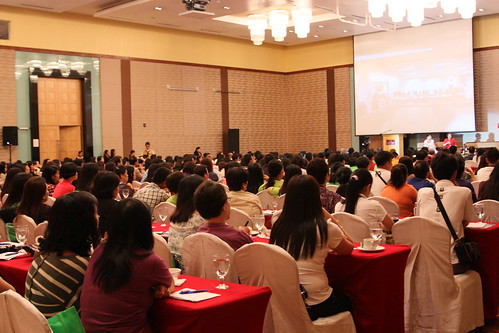
During the third day of the Philippine Pediatric Society Annual Convention 2015 on April 22, the organizers reserved a slot for a topic on developmental pediatrics. I guess this is one way to keep participants come to the very last day and not go to a tempting R and R during convention. Much more exciting is a "makabagbag damdamin" presentation cum personal sharing of a mother. The mother added flavor and spice to the lectures of two reputable developmental pediatricians in the persons of Dr. Rita de Guzman and Dr. Mimi Avancena. Their topics were on optimizing developmental health focusing on importance of language. As an attendee of this symposium I got refreshed from their lectures. But hey, that's the cognitive part.

The Participants of the Philippine Pediatric Society Symposium

Let me go back to the mother. She expounded on her journey as a parent to a noncommunicative autistic adolescent child of hers. She was emotional. Of course who would not? Getting the best speech therapist in the country for her dream to let Gio, her son, talk. It takes an affect to be inspired, a heart to be rekindled, and a mind to have the will for pediatricians and colleagues to be A-Ok. This mother is Dang Uy-Koe, an avid advocate, a passionate leader for ASP, a dear classmate of my husband and now my precious kumare in both inaanak and advocacies.

After leaving the symposium attendees didn't want to vacate their chairs. We were awed. We were struck. We were moved to do something. Why is there no clinic and hospital advocating for special children's privileges? The malls had their sensitivity trainings. The airlines had theirs as well. How about the hospital and clinic staff attending to our special children? Our patients have their own journey when they have their EEGs done or even a simple blood extraction when they get sick. Now is the time for our institutions to be A-Ok. Ask any Autism Society Philippines advocate. They will show us the way.

About the author: Edna Sarah Clemente-Morada, MD, FPPS, MHPEd. An ambulatory pediatrician practicing at The Medical City. She is Chair of the Medical Training Office, The Medical City."

 
Design by Free WordPress Themes | Bloggerized by Lasantha - Premium Blogger Themes | Sweet Tomatoes Printable Coupons